Search This Blog

Friday, August 15, 2014

Kerry reaffirms ‘ambitious agenda’ of U.S. engagement in Asia, Pacific


HONOLULU: Outlining what he termed the United States’ “ambitious agenda” of long-term engagement in Asia and the Pacific, U.S. Secretary of State John Kerry said yesterday in a policy speech at the East-West Center in Honolulu that complex challenges such as climate change and maritime territorial disputes can be transformed into opportunities for such advances as clean energy development and regional cooperation.
“We know that America’s security and prosperity are closely and increasingly linked to the Asia Pacific,” Kerry said. “That’s why President Obama began what is known as the rebalance to Asia in 2009, and that’s why he’s asked me to redouble my own efforts in the region.”
Speaking at the conclusion of his sixth trip to the Asia Pacific region as secretary, Kerry focused his remarks on four challenges in particular: fostering sustainable economic growth, transforming the climate change crisis into a clean energy “revolution,” turning territorial conflicts into regional cooperation and empowering individuals through gains in human rights and political freedom.
“These important opportunities can and should be realized through a stable, rules-based regional order built on norms of behavior that are reinforced by institutions,” Kerry said.
In terms of economic growth, Kerry focused on negotiations over the sweeping, 12-nation Tans-Pacific Partnership free trade agreement, or TPP. Negotiators had hoped to conclude a TPP agreement a number of months ago, but progress on the complex pact has slowed since then.
“When the Trans-Pacific Partnership negotiations are complete, about 40 percent of global GDP will be linked by a high-standard trade agreement that creates a race to the top,” Kerry said, “where people understand the rules of engagement and there’s accountability and transparency.” He said the TPP is a “state-of-the-art, 21st century trade agreement, and it is consistent not just with our shared economic interests, but also with our shared values. It’s about generating growth for our economies and jobs for our people by unleashing a wave of trade, investment, and entrepreneurship.”
Noting that he had just completed a visit to the Solomon Islands, where some areas are facing inundation due to sea level rise, Kerry emphasized that the effects of climate change are already occurring, and that the response has to be “all hands on deck. By definition, rescuing the planet’s climate is a global challenge that requires a global solution.”
Kerry said the solution is simple: clean energy development, which he said is already the fastest-growing segment of a global energy market that is “the biggest market the world has ever seen.”
Acknowledging that much of the challenge rests with the world’s two biggest carbon emitters, the United States and China, Kerry said that during their recent annual Strategic and Economic Dialogue, “we and China together sent a clear message: The world’s two largest greenhouse gas emitters are committed to advancing a low-carbon economic growth pattern and significantly reduce our countries’ greenhouse gases.”
He said the two countries are working together to launch demonstration projects on carbon capture, adopting stronger fuel efficiency standards and advancing a new initiative on deforestation and climate change.
He said the U.S. is also deepening partnerships with the Pacific islands and working through USAID and other multilateral institutions to increase the resilience of island communities.
“We’re elevating our engagement through the Pacific Islands Forum, and we’ve signed new maritime boundaries with Kiribati and the Federated States of Micronesia in order to promote good governance of the Pacific Ocean and peaceful relations among island nations,” Kerry said, adding that the U.S. is working on a “Pacific Pathway” of marine protected areas, including President Obama’s recent commitment to explore a protected area of more than a million square miles in the remote Pacific.
Turning to perhaps the most contentious issue in the region — territorial disputes between China and several other nations over small islands in the South and East China Sea, Kerry said the challenge is “to turn maritime conflicts into regional cooperation.”
“These disputes are really about more than claims to islands and reefs and rocks and the economic interests that flow from them,” he said. “They’re about whether might makes right, or whether global rules and norms and rule of law and international law will prevail.”
Kerry said he wanted to be “absolutely clear: The United States of America takes no position on questions of sovereignty in the South and East China Sea, but we do care about how those questions are resolved. … We firmly oppose the use of intimidation and coercion or force to assert a territorial claim by anyone in the region. And we firmly oppose any suggestion that freedom of navigation and overflight and other lawful uses of the sea and airspace are privileges granted by a big state to a small one.”
Kerry pointed to a recent settlement of a 20-year maritime boundary disagreement between Indonesia and the Philippines, as well as a fishing agreement last year between Japan and Taiwan, as examples of how these disputes can be resolved through good-faith negotiations. He also said that the U.S. supports steps by the Philippines to resolve its maritime dispute with China peacefully, including through the right to pursue arbitration under the UN Convention on the Law of the Sea.
Admitting that the U.S. itself has yet to ratify the convention, although it already follows its principles, Kerry said the United States “needs to finish the job and pass that treaty once and for all.”
A key element in maintaining regional peace and stability, Kerry acknowledged, is a “constructive” relationship between the U.S. and China. “President Obama has made it clear that the United States welcomes the rise of a peaceful, prosperous and stable China – one that plays a responsible role in Asia and the world and supports rules and norms on economic and security issues,” he said. “The President has been clear, as have I, that we are committed to avoiding the trap of strategic rivalry.”
However, he said, this “new model” relationship of great powers is “not going to happen simply by talking about it. It’s not going to happen by engaging in a slogan or pursuing a sphere of influence. It will be defined by more and better cooperation on shared challenges. And it will be defined by a mutual embrace of the rules, the norms, and institutions that have served both of our nations and the region so well.”
Kerry said he is pleased that China and the U.S. are cooperating on the Iran nuclear talks, have increased their dialog on North Korea and are also “cooperating significantly on climate change possibilities, counter-piracy operations and South Sudan.”
He reiterated the administration’s commitment to elevating engagement with Asia through multilateral institutions like the Asia Pacific Economic Cooperation, or APEC; the East Asia Summit; the ASEAN Regional Forum and others, while “revitalizing“ security partnerships with longtime treaty allies Japan, Australia, South Korea and the Philippines.
Addressing the final challenge on his list, Kerry said the U.S. also hopes to help “turn human rights problems into opportunities for human empowerment.”
“We all know that some countries in the region hold different views on democratic governance and the protection of human rights,” Kerry said. “But though we may sometimes disagree on these issues with the governments, I don’t think we have any fundamental disagreement with their people.
“Given a choice, I don’t think too many young people in China would choose to have less access to uncensored information, rather than more. I don’t think too many people in Vietnam would say: ‘I’d rather not be allowed to organize and speak out for better working conditions or a healthy environment.’ And I can’t imagine that anyone in Asia would watch more than 130 million people go to the polls in Indonesia to choose a president after a healthy, vigorous and peaceful debate and then say: ‘I don’t want that right for myself.’”
North Korea’s nuclear weapons activities, he said, “pose a very serious threat to the United States, the region, and the world, and we are taking steps to deter and defend against North Korea’s pursuit of a nuclear-armed ballistic missile capability. But make no mistake: We are also speaking out about the horrific human rights situation. … North Korea’s gulags should be shut down – not tomorrow, not next week, but now. And we will continue to speak out on this topic.”
During his visit last week to Burma, Kerry said, he saw first-hand the initial progress the country has made toward greater freedoms, “and I’m proud of the role – and you should be too – that the United States has played for a quarter of a century in encouraging that progress.”
But Burma ­– ­ also known as Myanmar – still has a long way to go, he said, and those leading its democratic transformation are only now addressing the deepest challenges: “Defining a new role for the military; reforming the constitution and supporting free and fair elections; ending a decades-long civil war; and guaranteeing in law the human rights that Burma’s people have been promised in name. All of this while trying to attract more investment, combating corruption, protecting the country’s forests and other resources. These are the great tests of Burma’s transition. And we intend to try to help, but in the end the leadership will have to make the critical choices.”
He said the U.S. is going to do everything it can to help reform in Burma, especially by supporting nationwide elections next year. “And we will keep urging the government — as I did last week — to take steps to ease the humanitarian crisis in Rakhine state, and push back against hate speech and religious violence, implement constitutional reform, and protect freedom of assembly and expression,” he said. “The government owes it to the people to do those things.”
Referring to the recent unrest and yet another military coup in longtime U.S. ally Thailand, Kerry said the administration is “very disturbed by the setback to democracy, and we hope it is a temporary bump in the road. We call on the Thai authorities to lift restrictions on political activity and speech, to restore civilian rule, and return quickly to democracy through free and fair elections.”
Summing up the U.S. agenda of what he called “super engagement” in the region, Kerry said: “I have no illusions about the challenges, and nor does President Obama. But what I want to emphasize to you all today is there is a way forward. … We are ambitious for this process: completing the TPP negotiations, creating sustainable growth, powering a clean energy revolution, managing regional rivalries by promoting cooperation, and empowering people from all walks of life — that’s how we’re going to realize the promise of the Asia Pacific.
“This is a region whose countries can and should come together, because there is much more that unites us than divides us. This is a region that can and should meet danger and difficulty with courage and collaboration. And we are determined to deliver on the strategic and historic opportunities that we can create together.” PNA

source:  Manila Times

Thursday, August 14, 2014

China creates an enemy

How China made the Philippines an enemy when the two countries could have been close collaborators in this part of Asia is the topic of one chapter in the book “The Rise of China vs. The Logic of Strategy” by Edward N. Luttwak. The book was recommended to me by Chito Sta. Romana, president of the Philippine Association for Chinese Studies.
Chito is a graduate of De La Salle University-Manila and was the Beijing Bureau head of the American Broadcasting Corporation (ABC News). He was then considered as ABC News’ China expert and is now the foremost China expert in the Philippines. By the way, he speaks, reads and writes perfect Mandarin.
Here are selected paragraphs, from the book, that I found especially interesting:
“From a Chinese and strategic point of view , the Philippines was little more than an extension of the United States until September 16, 1991, when the Philippine Senate amid great display of emotion voted 12 to 11 to reject a treaty that would have leased the Subic Bay Naval Station to the US for another ten years. Instead the last US sailor departed on November 24, 1992 and by then the United States had already evacuated Clark Air Base which had been heavily damaged by a 1991 volcanic explosion.”
After analyzing the reason why the Senate possibly rejected the treaty, Luttwak then discussed the effects on the Philippine-China relationship. He wrote:
“Although the 1991 vote did not repeal the 1852 US Philippine Mutual Defense Treaty, it did remove all American forces and then changed fundamentally the strategic disposition of the country, potentially opening it up to Chinese influence as never before. There were impediments, to be sure, including a historic Chinese ethnic presence in the Philippines that had negative as well as positive aspects and strong links with Taiwan – though the Philippines preceded the United States for four years in switching diplomatic recognition to the People’s Republic of China on June 9, 1975. Overall, however, the Chinese were very well positioned to supplant the United States as the benevolent greater state on the scene that could gradually evolve into a potentially protective power.”
Opinion ( Article MRec ), pagematch: 1, sectionmatch: 1
There was a period, especially during the presidency of Gloria Arroyo, when it seemed that there was a real possibility of China supplanting the United States as the main source of investments for the Philippines. This was the period of major Philippine government officials, including President Arroyo and the First Gentleman were reported playing golf in China and meeting with possible investors in private conferences.
This was the time the NBN-ZTE deal was in the works. There were even serious negotiations for China to build and finance the construction of the Luzon North Rail and South Rail. It seemed that we would see a railway linking the Ilocos coast with the Bicol region.
Two events stopped these deals and eventually ended any chance even of a renegotiation. The first reason was that the NBN-ZTE and North Rail became entangled in allegations of bribery and other scandals that implicated GMA, the First Gentleman and Romulo Neri.
The second and bigger reason was the increased conflict in the West Philippine Sea between the Philippines and China. It became serious when China suddenly declared ownership of islands and reefs within the Philippine maritime boundaries.
In April 5, 2011, the Philippines sent to the United Nations Secretary what is called in diplomatic parlance as a Note Verbale. The official letter to the UN said that the Kalayaan Island Group (Spratly Islands) “claimed and occupied by the Philippines constitutes an integral part of the Philippines...” This was before the Philippines agreed to a mutual withdrawal from the disputed islands. The Philippines withdrew as per agreement, but the People’s Republic refused to withdraw.
The Chinese replied to the Philippine Note Verbale on April 14 2011 in a language that left no room for diplomatic negotiation. Here are excerpts from that Chinese Note  Verbale:
“China has undisputed sovereignty over the islands in the South China Sea and adjusting waters...its related rights and jurisdiction are supported by abundant historical and legal evidence...The contents of the Philippine Note  Verbale...are totally unacceptable to the Chinese government.
The so-called Kalayaan Island Group claimed by the Republic of the Philippines is in fact part of China’s Nansha Islands...Since 1970s the Republic of the Philippines started to invade and occupy some islands and reefs of the Chinese Nansha Islands...These acts constitute infringement upon China’s territorial sovereignty. Under the legal doctrine of “es injuria jus nun oritur” the Philippines can in no way invoke such illegal occupation to support its territorial claim.”

There were many geopolitical consequences arising from the escalation of tensions between the two countries. Here are excerpts from Luttwak’s book explaining some of these consequences:
“Since then, Sino-Philippine relations have unfolded in the different ways that have become normal under deadly workings of what was earlier defined as China’s acquired strategic deficiency syndrome: China’s overbearing, even threatening conduct has driven the Philippines back into a protective relationship with the United States.
No Sino-Philippine war is imminent, but there already is warlike conduct by way of sudden occupations and overnight constructions and by maritime harassments...It can definitely be said that Sino-Philippine relations have evolved very dynamically...there is nothing like a territorial claim pressed aggressively, if the aim is to ruin amity....Once again, Chinese conduct has driven a possible partner into the arms of the United States.”
Chapter 19 of Edward Luttwak’s book is the story of how the People’s Republic of China turned the Philippines from a potential ally into an unwilling but now a clearly defiant enemy.
source:   (The Philippine Star)

Thursday, June 26, 2014

China’s new map covers West Philippine Sea

China has unveiled a new map of its entire country that shows its claim over the West Philippine Sea (South China Sea) marked by not just nine but 10 dash lines around the region.

Xinhua, a government run news agency, published the photo of the map on its website on June 24 at around 8:00 p.m (China time). The photo caption reads: “Islands in South China Sea share the same scale with mainland and are better shown than traditional map.”

China map, China new map, Manila Bulletin, mb.com.ph, China, West Philippine Sea, South China Sea
The photo of China’s new map. (Xinhua/Bai Yu)

The new map created by Hunan Map Publishing House shows China claiming the West Philippine Sea which stretches down the coasts of Philippines, Vietnam and Malaysia.

The ruling Communist Party’s official People’s Daily on its website said the islands of the South China Sea on the traditional map of China are shown in a cut-away box that causes readers not to “fully, directly know the full map of China.”

Meanwhile, Department of Foreign Affairs (DFA) Spokesperson Charles Jose told Manila Bulletin Online that China’s publication of the new map is “precisely such ambitious expansionism” that causes tensions in the West Philippine Sea.

“We reiterate that such a publication only shows China’s unreasonably expansive claim that is clearly contrary to international law and UNCLOS,” Jose said in a text message.

The Philippines has been embroiled in a dispute with China over ownership of the West Philippine Sea.

The West Philippines Sea is a major shipping lane that is rich in oil and natural gas reserves.


source:  Manila Bulletin

Friday, June 13, 2014

Japan should have role in fixing Asia conflicts, Australia says

JAPAN should play a bigger part in resolving conflicts in the Asia-Pacific region, where it is caught up in a territorial dispute with neighbor China, Australian Foreign Minister Julie Bishop said.

“We see Japan taking an ever increasing role in some of the areas of conflict, some of the challenging environments,” Bishop said in a phone interview from Tokyo on Thursday.

Japanese Prime Minister Shinzo Abe is seeking to reinterpret the country’s pacifist Constitution to allow it to defend allies, as part of a broader push for influence in the region as China asserts itself as an economic and military power.

Japan and China are embroiled in a dispute over islands in the East China Sea and China is pressing its claims to a large part of the South China Sea, a major trade route.

Japan has a right to collective self-defense, Bishop said after concluding “two-plus-two” meetings with Defense Minister David Johnston and her Japanese counterparts, Foreign Minister Fumio Kishida and Defense Minister Itsunori Onodera.

“We support Japan’s desire to achieve peace and security for the long term in our region,” she said. “We welcome Japan’s efforts to play an even greater role in regional affairs and global affairs.”
Abe, who has increased defense spending two years in a row, used the Shangri-La security forum in Singapore last month to outline his efforts to toughen Japan’s defense posture and pledged to aid Southeast Asian nations in their disputes with China over territory.
He framed Japan’s plans for a more active contribution to security as the path for “new Japanese.” That prompted Chinese Lt. Gen. Wang Guanzhong to call Abe’s comments provocative.

Chinese fighter jets on Wednesday flew “abnormally close” to Japanese military surveillance planes in the East China Sea, the second incident in less than a month, Japan’s Ministry of Defense said. Ships and planes from the countries have tailed one another around the islands known as Senkaku in Japanese and Diaoyu in Chinese since Japan bought three of them from a private owner in 2012.
While China is committed to a peaceful rise in power in the Asia-Pacific, a strong US presence in the region is vital to prosperity and stability, Bishop said.

“Our point in all of our discussions, whether it be with the United States or Japan or China or any of the Asean countries, is that there must be a peaceful resolution to these territorial claims,” Bishop said, referring to the 10-member Association of Southeast Asian Nations. “The key to managing disputes in the South China Sea is to ensure that the Asean countries continue to engage in negotiations for a code of conduct.”

Australia is also seeking to build its defense capacity. The world’s 12th-largest economy must balance its interests between the US—a strategic ally that has Marines based in the northern Australian city of Darwin—and top trading partner China, which Bishop criticized last year for proclaiming an air defense identification zone over the East China Sea.

Australia, which is in talks to potentially use submarine technology from Japan, on Wednesday reached a “substantial conclusion” to negotiations with Kishida and Onodera in their bid for cooperation in sharing defense equipment and technology, the nations said in a joint statement. Further details are expected next month when Abe addresses the Australian parliament in Canberra, Bishop said on Thursday. 

source:  Bloomberg News / Business Mirror

Thursday, June 12, 2014

South China Sea contract to be extended

FORUM ENERGY Plc will be granted a two-year extension of its contract for an exploration area located in a disputed part of the South China Sea, a Cabinet official yesterday said.

The firm, majority owned by Philex Petroleum Corp., has said it needs more time to drill appraisal wells called for under Service Contract (SC) 72, which will expire in August 2015.

“We will grant it. The usual two years [extension]. We don’t have any reason not to grant it,” Energy Secretary Carlos Jericho L. Petilla told reporters yesterday.

A meeting, “hopefully within this week or next week”, will be held with Forum Energy officials, he added.

Manuel V. Pangilinan, Philex Petroleum chairman, last month said that Forum Energy needed more time to conduct exploration work.

SC 72, granted by the Energy department in February 2010, upgraded a concession acquired by Forum Energy in April 2005. It includes an obligation to drill the wells by August 2011 but this was extended last year to August 2015 to avoid further inflaming a row with China, which claims most of the resource-rich South China Sea.

Mr. Pangilinan has said that rig mobilization will take around 12-18 months, so Forum Energy was looking to commence drilling activity in the Sampaguita gas field “sometime in the first or second quarter of 2016”.

Philex Petroleum holds a 60.49% interest in Forum Energy, which in turn holds 70% interest in SC 72.

Mr. Pangilinan also confirmed that Forum Energy was reviving talks on a possible partnership with China National Offshore Oil Corp. to develop the prospect.

Shares of Philex Petroleum shed one centavo or 0.14% to close at P7.10 apiece yesterday. -- Claire-Ann Marie C. Feliciano


source:  Businessworld

Wednesday, June 11, 2014

Vietnam urges China to withdraw oil-drilling rig in disputed area

Vietnam’s United Nations ambassador urged China on Tuesday to withdraw its oil rig and more than 100 ships from the South China Sea to create “an environment” for negotiations on the disputed waters.

But Ambassador Le Hoai Trung said in an interview with the Associated Press that Beijing refuses to engage in dialogue and insists there is no dispute, claiming the area around the rig belongs to China.
The escalation in tensions is the most serious in years between Vietnam and its massive northern neighbor, which claims nearly all of the South China Sea.

China sent the rig into the disputed waters on May 1, provoking a confrontation with Vietnamese ships, complaints from Hanoi and street protests that turned into bloody anti-Chinese riots. Hundreds of factories were damaged, and China said four of its citizens were “brutally killed” and over 300 wounded.

Trung said “some extreme elements” provoked by China’s deployment of the rig undertook actions which the government “very much regrets.” He said many suspects have been arrested and prosecuted, and the government has taken measures to prevent a repetition of the violence.

Both Vietnam and China have taken the dispute over the rig to the United Nations, circulating rival documents among the UN General Assembly’s 193 member- states. Vietnam has said it is considering legal action against China in an international court. China has accused Vietnam of “illegally and forcefully” disrupting the rig’s operation by sending armed ships and ramming Chinese vessels.

The oil platform is about 32 kilometers (20 miles) from the China-controlled Paracel Islands, which Vietnam claims, and 278 kilometers (173 miles) from the coast ofVietnam.

Trung said Vietnam has “the legal basis and historical evidence to affirm our sovereign rights over the area” where the rig is deployed, which the country says is part of its exclusive economic zone and continental shelf.

The ambassador said China’s refusal to discuss the dispute is provocative and raises “serious concerns.”

“We don’t want to be provocative with this issue,” he said. “We want to have negotiations, to have dialogue, or any other means of peaceful settlement of the dispute.”

He added, “Up until now we exercise our restraint, but of course we always, like any other country, reserve the right of self-defense.”

Trung stressed, however, that after decades of war the Vietnamese people want peace “and friendly relations with China.”

source:  AP / Business Mirror

Monday, June 9, 2014

China sea claims have no basis: SC Justice

CHINA’S NINE-dashed line claim in the West Philippine Sea could not be supported by evidence, a Supreme Court (SC) Justice said, pointing to ancient maps and historical data which debunk Beijing’s claims over disputed waters.

“Clearly there is nothing ‘historical’ or ‘right’ about China’s nine-dashed line claim. The nine-dashed line claim is based not on historical facts but on historical lies,” Associate Justice Antonio T. Carpio said in 63-page report.

“In sum, China’s so-called ‘historical facts’ to justify its nine-dashed lines are glaringly inconsistent with actual historical facts, based on China’s own historical maps, Constitutions and official pronouncements,” he added.

Mr. Carpio said China has no historical link to Scarborough Shoal.

“The rocks of Scarborough Shoal were never bequeathed to the present generation of Chinese by their ancestors because their ancestors never owned those rocks in the first place,” Mr. Carpio said.

Mr. Carpio, citing historical maps and data, pointed out that China’s southernmost territory of China “has always been” Hainan island, the smallest and southernmost province of the country.

“The southernmost territory of China under its imperial dynasties was always Hainan island, and has remained so under several Constitutions of the Republic of China,” Mr. Carpio said.

Mr. Carpio has been among the vocal critics of China’s nine-dashed line, which claims almost the entire South China Sea, encroaching the 200-nautical mile exclusive economic zone (EEZ) of countries around the disputed waters, including that of the Philippines.

A United Nations arbitral tribunal has already asked China to answer the Philippines’ plea on overlapping claims in the West Philippine Sea.

China, however, said it would not participate in the proceedings. The Philippines, has submitted to the tribunal its memorandum asserting its claim to disputed islands within the West Philippine Sea through a 4,000-page, 10-volume “memorial” serving as proof of its sovereignty within its 200-nautical mile exclusive economic zone.

The country’s move to seek international arbitration prompted China to accuse the Philippines of violating morality and international law to resolve the territorial dispute.

Meanwhile, the government is yet to verify reports that China is planning to build a military base at the disputed Kagitingan Reef, a Malacañang official said yesterday.

“The report that China is building up on the Fiery Cross Reef was reported over the weekend on a Chinese newspaper, so that still needs verification,” Presidential Spokesperson Edwin S. Lacierda told a press briefing yesterday, adding he does not want to comment on questions regarding the options of the Philippines in case China declares an air defense identification zone (ADIZ) over the West Philippine Sea.

“On the ADIZ over South China Sea, that is purely speculative at this point, so hypothetical at this point, so we don’t want to speculate,” he said.

DIPLOMATIC TRACK
The Palace Spokesman reiterated the country will continue to push the diplomatic track against the escalating tensions over the West Philippine Sea, amid China’s seeming expanded activities in the disputed shoals.

Mr. Lacierda noted that the country’s move for a peaceful resolution to disputes has been gaining approval from the international community.

He said the Philippines does not want to further escalate the tensions over the contested waters.

“We will continue to resort to the diplomatic track that we have resorted to and that particular track has been gaining approval from the international community,” Mr. Lacierda said.

“Certainly, we do not want to escalate any tensions in the South China Sea. That is not what we are there for and, therefore, the best thing that we can do is to resort to the diplomatic mechanism,” he added.

Mr. Lacierda said that with the growing support for a peaceful resolution to the maritime rows from the international community, the country is hoping that China will change its mind and participate in arbitration initiated by the Philippines to resolve the territorial disputes among countries in Asia.

“People seem to underestimate the power of the diplomatic track, [but] we believe that with the international community’s support, we can persuade China to act as a responsible member of the international community. And also that China realizes the importance of being a member of the international community in good standing,” Mr. Lacierda said.

NEWS REPORT
Mr. Lacierda’s statement comes on the heels of a South China Morning Post report on Saturday indicating that China plans to put up a military base in the disputed Kalayaan Island Group amid escalating tensions over maritime territorial rows with regional neighbors in Asia.

In its report, South China Morning Post said: “A military base will be built after the planned expansion of an artificial island located on Fiery Cross Reef”, which the Philippines refers to as Kagitingan Reef.

The planned military base, the report noted, will feature an air strip and a port which will also house storage facilities for military supplies. An observation post on the reef already exists, the report added.

Should China push through with the said plan as announced, the Asian economic giant will have the most strategic outpost in the heart of the disputed territories over the West Philippine Sea, the Spratly Group of Islands, Professor Jay L. Batongbacal of the College of Law Maritime Affairs and Law of the Seas of the University of the Philippines (UP) said.

“It makes perfect strategic sense in terms of asserting its claim such bases will enable China to carry out its current operations versus other claimant countries on a continuous basis 24/7 operations,” he told BusinessWorld in a text message.

In terms of its strategic competition with the US, Mr. Batongbacal added that a base in the West Philippine Sea, “is essential to be able to monitor and constrain US naval movements.”

“A base in the South China Sea is China’s solution to US increased rotational presence in the region. A full-blown military base will also support China’s military movements. Instead of making do with small outposts that have limited capacity and capability to support maritime operations, bases will give China all the capabilities it needs to elbow everyone else out of their current position,” Mr. Batongbacal further explained.

ASEAN MEETINGS
Meanwhile, the Philippines also renewed its call for the peaceful, rules-based resolution of disputes in the West Philippine Sea and South China Sea during high-level meetings of the Association of Southeast Asian Nations (ASEAN), ASEAN Plus Three (APT), East Asia Summit (EAS) and ASEAN Regional Forum (ARF) in Yangon, Myanmar.

Foreign Affairs Undersecretary Evan P. Garcia, Philippine Senior Official and Head of Delegation to the meetings, emphasized that recent provocative and unilateral actions by China constitute an infringement on the rights of the Philippines and other countries under the UN Convention on the Law of the Sea (UNCLOS), and a violation of the 2002 ASEAN China Declaration on the Conduct of Parties in the South China Sea (DoC).

He called on all parties to exercise self-restraint as provided by paragraph 5 of the DoC, citing that these unilateral actions “raise the level of tensions to a new high and undermine the spirit of good neighborly ties and mutual confidence necessary for the region to move forward and decisively to implement the DoC fully and effectively.”

Mr. Garcia stressed the urgency for ASEAN and China to expeditiously conclude a substantive and legally binding Code of Conduct in the disputed waters. Noting that the Arbitral Tribunal has fixed Dec. 15, 2014 as the date by which China should submit its response to the Philippine memorial, Mr. Garcia noted that the Philippines has invited China from the very beginning to take part in the peaceful, rules-based process to clarify the extent of its maritime claims before the international community.

He said the Philippines called for regional maritime norms which are compliant with international law to promote good order at sea, to serve as confidence-building measures and to reduce risks of miscalculation.

The series of meetings hosted by Myanmar, chair of ASEAN this year, began last Saturday, to prepare for the Ministerial Meetings in August.

The said meetings reviewed the progress of regional cooperation in comprehensive areas and discussed strategic and security issues affecting the Asia-Pacific region.

Aside from calling for a peaceful means to mend ties with China over escalating tensions, the Palace Spokesman maintained the Philippines’ relationship with the Asian economic giant is not solely dependent on the conflict with them in the South China Sea or the West Philippine Sea.

“Again, our relationship with China is multi-faceted, plus the fact that we have a number of Filipino-Chinese members in our country. We have always had very good relations with China in the other areas of exchange -- people-to-people, tourism, trade -- so I think it should not be a concern for us because, again, we have a very rich relation with China which is not limited to the current situation in the West Philippine Sea,” Mr. Lacierda said.

He added that President Benigno S. C. Aquino III is set to attend today, the joint celebration of the 116th Philippine Independence Day and 13th Filipino-Chinese Friendship Day at the Manila Hotel, organized by the Federation of Filipino-Chinese Chambers of Commerce and Industry, Inc. (FFCCCII).

Mr. Lacierda said the President will deliver a speech, during which, he will highlight the contributions of the Filipino-Chinese community not only to the growth of our economy but also to the enhancement of civic life.

The joint celebration marks the 13th Filipino-Chinese Friendship Day, the Palace Spokesman added, which is celebrated on June 9. Ambassador Zhao Jianhua of the People’s Republic of China will also deliver a message.

Earlier, the President confirmed China has expanded its activities on the disputed waters revealing he has received reports on the presence of Chinese ships in more areas in the disputed shoals over the West Philippine Sea, particularly in Gavin Reef and Cuarteron Reef in the Kalayaan Group of Islands.

Last month, the Philippine government tagged China’s reclamation activities in Mabini Reef as “illegal” accusing Beijing of violating the DoC.

The Chinese activity was first monitored by the Philippines in February 2014. On May 15, the Department of Foreign Affairs released photos of China’s “destabilizing” moves in the disputed seas.

‘A FARCE’
China yesterday expressed displeasure after Vietnamese and Filipino troops played sports together on a contested island, with the foreign ministry denouncing the activity as “a farce.”

The retort from Beijing came a day after Vietnam hosted Filipino troops on an island it controls in the disputed Spratlys archipelago in the South China Sea that the Philippines’ Navy said was designed to “foster camaraderie.”

Asked about the joint sports activity, Chinese foreign ministry spokeswoman Hua Chunying said at a regular briefing: “Don’t you think that these small tricks conducted by the Philippines and Vietnam are nothing but a farce?”

She also urged Hanoi and Manila to “refrain from taking any actions that may complicate or magnify the dispute” and said that China “exercises indisputable sovereignty over the Nansha Islands and adjacent waters”, referring to the Spratlys by their Chinese name. -- with Imee Charlee C. Delavin (Businessworld) and AFP

Sunday, June 1, 2014

Snubs, harsh words at Asia security meet as US and Japan rile China

SINGAPORE (Reuters) - When Japan's defence minister greeted the deputy chief of staff of China's army at a regional security forum this weekend, he was undiplomatically snubbed.
Lieutenant General Wang Guanzhong said he was incensed by comments from Japananese Prime Minister Shinzo Abe implicitly holding China responsible for territorial disputes in the East and South China Seas and later by U.S. Defense Secretary Chuck Hagel's accusations that Beijing was destabilising the region.
"When Mr Abe spoke just now, there was veiled criticism targeted at China," Wang told Japanese Defence Minister Itsunori Onodera, according to the semi-official China News Service. "These accusations are wrong and go against the standards of international relations."
The exchange between the world's three biggest economies at the Shangri-La Dialogue in Singapore, a security forum for government officials, military officers and defence experts, were among the most caustic in years at diplomatic gatherings, and could be a setback to efforts to bring ties back on track.
It was the first such major conference since tensions have surged in the South China Sea, one of Asia's most intractable disputes and a possible flashpoint for conflict.
Tellingly, despite around 100 bilateral and trilateral meetings taking place over the week, officials from China and Japan did not sit down together.
China's Wang had rejected an offer of talks with Japan and said: "This will hinge on whether the Japanese side is willing to amend the erroneous policy towards China and improve relations between China and Japan. Japan should correct its mistakes as soon as possible to improve China-Japan ties."
Wang later accused the United States of hegemonism, threats and intimidation.
China claims almost the entire oil- and gas-rich South China Sea, and dismisses competing claims from Taiwan, Brunei, Vietnam, the Philippines and Malaysia. Japan has its own territorial row with China over islands in the East China Sea.
Riots broke out in Vietnam last month after China placed an oil rig in waters claimed by Hanoi, and the Philippines said Beijing could be building an airstrip on a disputed island.
Tensions have been rising steadily in the East China Sea as well. Japan's defence ministry said Chinese SU-27 fighters came as close as 50 metres (170 ft) to a Japanese OP-3C surveillance plane near disputed islets last week and within 30 metres of a YS-11EB electronic intelligence aircraft.
On Sunday, Wang stepped up the rhetoric.
"Mr Abe, as the head of a country and as someone the organisers have invited to give a speech, is supposed to stick to the event's aim in boosting security in the Asia Pacific region," he said. "However Mr Abe went against the aim of the event by instigating disputes."
Despite the heated words, analysts do not believe relations have deteriorated beyond reach.
"In the past, there was a sense we were sailing towards stability," said Kishore Mahbubani, dean of the Lee Kuan Yew School of Public Policy at the National University of Singapore.
"Now people worry. Overall, things are going in the right direction. Nobody thinks there will be war, but there is a level of unease which is new."
JAPAN'S COMING OUT
China has been particularly aggrieved by Japan trying to woo Southeast Asia.
In his keynote address to the conference, Abe pitched his plan for Japan to take on a bigger international security role and said Tokyo would offer its "utmost support" to Southeast Asian countries in their efforts to protect their seas and airspace. It is part of his nationalist agenda to loosen the restraints of the pacifist post World War Two constitution and to shape a more muscular Japanese foreign policy.
Philip Hammond, the British defence minister, said Abe's agenda was well know but provoked a response because it was laid out publicly.
"It's certainly the first time I had heard him articulate it on a public platform in that way," he said.
Japan's growing proximity to Washington is also a worry for Beijing.
"What really worries them is that Japan and the U.S. are in a very strong alliance and seem to be pulling closer, that was clear at this year's dialogue," said Tim Huxley, executive director of the International Institute of Strategic Studies in Asia, the organiser of the forum.
"Rightly or wrongly, that will be seen by the Chinese as threatening them because it will mean they will be facing a more coherent alliance."
Still, the row is not likely to spill over. The three nations have deep economic and business ties, which none of them would like to see disrupted.
"Relations are definitely not at a breaking point," said Bonnie Glaser of the Washington-based Centre for Strategic and International Studies and a regular visitor to the dialogue.
"Leaders are aware that their countries have huge stakes in this relationship and they are committed to trying to find areas where interests do overlap, where they can work together."
Beijing, she said, had compartmentalised various aspects of its relationship with Japan and the United States. "There is a wider strategy from China, though we don’t see that here, partly because it's a security forum."
William Cohen, a former U.S. secretary for defence, said the strong words from the United States and Japan were necessary.
"China is growing, it's maturing, it's also feeling its oats a bit and throwing its weight around. That is normal if they see no counterweight. It's incumbent upon us to say, okay, there are limits. These things have to be said."
(Additional reporting by Chyen Yee Lee; Editing by Alex Richardson)
source:  Yahoo! and Reuters

Friday, May 9, 2014

Japan 'deeply worried' by China-Vietnam maritime spat

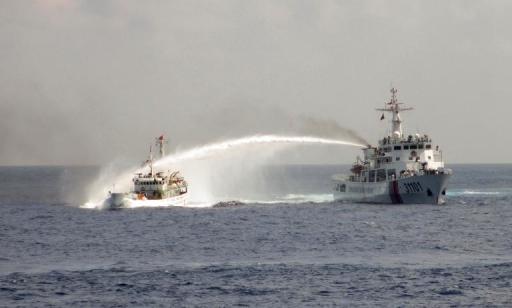
In this file photo, a China Coast Guard ship is seen using a water cannon on a Vietnamese ship in the disputed waters in the South China Sea, on May 2, 2014

Japan said on Thursday it was "deeply worried" by China's behaviour in a spat with Vietnam over contested waters, and urged Beijing to rein in its "provocative" actions.

The comment comes after Hanoi said Chinese vessels rammed its patrol ships and turned water cannon on them near a controversial drilling rig in a disputed patch of the South China Sea.

It also comes as Japan and China continue to face off in their own territorial row over a small island grouping in the East China Sea and amid claims that Beijing is becoming increasingly assertive.

"We have strong concerns as there is information that many Vietnamese vessels were damaged and some people were injured," Chief Cabinet Secretary Yoshihide Suga told reporters in Tokyo.

"We are deeply worried as regional tensions have risen with China unilaterally starting rigging activities in disputed waters" in the South China Sea, the top government spokesman said.

"We recognise this incident is part of China's unilateral and provocative maritime activities," he said.

Suga said China should explain to Vietnam and the international community the basis on which it was acting and added Japan strongly wants China to refrain from provocative moves and "act in a self-restrained manner".

Hanoi said Wednesday that Chinese ships protecting a deep-water drilling rig in disputed waters had used water cannon to attack Vietnamese patrol vessels and had repeatedly rammed them, injuring six people.

Tensions between the communist neighbours have risen sharply since Beijing unilaterally announced last week it would relocate the rig -- a move the United States has described as "provocative".

Vietnam deployed patrol vessels after the China Maritime Safety Administration issued a navigational warning on its website saying it would be drilling close to the Paracel Islands -- which are controlled by China but claimed by Vietnam.

The two countries, who fought a brief border war in 1979, have been locked in a longstanding territorial dispute over the waters, and frequently trade diplomatic barbs over oil exploration, fishing rights and the ownership of the Spratly and Paracel Islands.

China claims sovereign rights to almost the whole of the South China Sea, leading to disagreements with other countries that surround the sea, chiefly with the Philippines, which has proved willing to stand up for itself.

Beijing's dispute with Japan is one of the more volatile flashpoints in regional relations, with both sides deploying paramilitary vessels -- backed at a distance by naval ships -- to the contested Senkaku islands, which China calls the Diaoyus.

The disputes have given common cause to Japan, the Philippines and Vietnam, with Manila particularly welcoming of Tokyo's moves to toughen up its defence stance, which it sees as offering a counterbalance to growing Chinese power.


source:  Yahoo!

Friday, April 4, 2014

China shelves Recto gas talks

Philex Mining Corp. and China National Offshore Oil Co. Ltd. have temporarily shelved talks over the joint development of the gas-rich Recto Bank in South China Sea, an area claimed by both Manila and Beijing.

Philex Mining chairman Manuel Pangilinan said negotiations between the two companies had stopped and that there were no plans to revive the talks soon.

Philex Mining owns 64.45 percent of Forum Energy Plc, which holds a 70-percent interest in Service Contract 72, including Recto Bank.  CNOOC is an upstream oil and gas firm owned by the Chinese government.

“We have not heard from them in a few months… Well, I guess by default. There is no communication to that effect.  The communication just died down,” Pangilinan said.
He said there were no plans yet to revive the talks with CNOOC. “For a moment, there’s no plan. We are busy for some other matters,” he said.

Pangilinan earlier expressed hope about forging an agreement with CNOOC that would pave the way for exploratory drilling at SC 72, which covers an 8,800-square kilometer area west off Palawan. SC 72 is estimated to contain as much as 16.6 trillion cubic feet of gas and 416 million barrels of oil.

“We would hope to do that...reach a commercial basis to further exploratory and drilling work on the concession but further subject to approval of their government and our government,” Pangilinan said earlier.

Pangilinan also said having CNOOC as a partner could defuse the political tensions hounding SC 72.
“I cannot predict the political situation, but if, and if, that is a speculative if…They are a state-owned clearly identified with China, so I’m assuming the political aspects would recede in the background,” Pangilinan said.

Pangilinan said Forum was keen on developing SC 72, but security issues under the territorial dispute prevented them from doing so.

He said Forum wanted to conduct exploratory drilling “as soon as possible,” or once the security issues were addressed.

 Forum Energy’s work program called for the drilling of two exploratory wells until August 2015.
 “We are a Philippine contractor so we are bound by Philippine law so we cannot do that if we do not conform to Philippine laws. We have to recognize Philippine sovereignty,” Pangilinan said.
 
source:  Manila Standard Today