Search This Blog

Friday, June 28, 2013

Japan vows to help Philippines amid China sea row

Japan pledged on Thursday to help the Philippines defend its "remote islands", as both governments expressed concern over China's robust moves to stake its claims to disputed Asian waters.

Japanese Defence Minister Itsunori Onodera said China's contentious claim to nearly all of the South China Sea and its territorial dispute with Japan in the East China Sea were discussed during top-level talks in Manila.

"We agreed that we will further co-operate in terms of the defence of remote islands... the defence of territorial seas as well as protection of maritime interests," Onodera told a joint news conference.
"We face a very similar situation in the East China Sea of Japan. The Japan side is very concerned that this kind of situation in the South China Sea could affect the situation in the East China Sea," he said, speaking through an interpreter.

Philippine Defence Secretary Voltaire Gazmin welcomed Japan's offer of support for its poorly resourced military.

"We have agreed to continue our exchanges of information, exchanges of technology to help each other to make our defence relations stronger," Gazmin said.

Neither side offered specifics but Philippine Foreign Affairs Secretary Albert del Rosario said in February his country was expecting to get 10 new Japanese patrol boats within 18 months.

The Japanese military brutally occupied the Philippines during World War II, but the two countries have since grown closer due to trade and investment, and more recently, through China's assertiveness.

Del Rosario told the Financial Times newspaper in December that a rearmed Japan would help the region counter-balance China.

Onodera and Gazmin also on Thursday welcomed an increased military presence in Asia by their mutual ally, the United States.

However Onodera said Japan was intent on avoiding conflict with China.

"I would also like to emphasise here that the current situation should not be changed with the use of force but should be done through the rule of law," Onodera said.

China claims most of the South China Seam including waters close to its neighbours' coasts. The Philippines, Brunei, Malaysia, Vietnam and Taiwan also have competing claims.

The Philippines has complained of increased Chinese "bullying" in the contested waters in recent years, and infuriated China by appealing to allies Japan and the United States for help.

The Philippines says China last year occupied an atoll well within the Filipino exclusive economic zone.

Tensions between China and Japan have also escalated over competing claims to the Japanese-held Senkaku islands, which Beijing calls the Diaoyus, in the East China Sea.

source:  AFP thru Yahoo!

Thursday, June 27, 2013

Beneficial relations exist despite the One China Policy

In response to Mr. Francisco S. Tatad’s June 24 analysis entitled “War clouds on the horizon,” the Taipei Economic and Cultural Office in the Philippines would like to make some clarifications.

The First Preparatory Meeting on Fisheries Cooperation between TECO and its counterpart—the Manila Economic and Cultural Office (MECO)—was held last June 14, 2013 in Manila. The meeting has proven to be fruitful with both sides pledging to avoid the use of force or violence to prevent incidents similar to the May 9 Guang Da Xing No.28 shooting from recurring. Both parties have also agreed to meet for the second round of talks in the future.

Although the Republic of China (Taiwan) has ceased its diplomatic ties with the Philippines since 1975, our two countries have still maintained cordial and mutually beneficial relations, and have concluded a total of 27 memorandums of understanding or agreements under the TECO-MECO framework, ranging from the fields of agriculture, education, labor, tourism and health cooperation…etc. Among these bilateral agreements is the Agreement on Mutual Legal Assistance (AMLA) in Criminal Matters inked on April 19, 2013, which provides the legal mechanism for both countries to conduct parallel but cooperative investigation on the Guang Da Xing No. 28 shooting incident.

We would also like to point out that the Taiwan-Philippine fisheries talk is aimed at preserving and advancing the interests of our two peoples and has no connection with the One China Policy. As a matter of fact, Japan, one of the countries that adheres to the One China Policy and thus has no diplomatic ties with the ROC, has still concluded a fishery pact with Taiwan last April. As the Taiwan-Japan fishery pact has significantly eased the tensions in the East China Sea, Taiwan and the Philippines may also observe the aforementioned successful practice adopted by Taiwan and Japan to jointly transform our two countries’ overlapping waters into an “Ocean of Peace and Prosperity”.

It is also worth noting that the signing of the United Nations Convention on the Law of the Sea (UNCLOS) by two countries or entities is not a prerequisite for these two sides to conclude a bilateral fishery agreement with each other. For instance, the United States has not been a party to the UNCLOS, but it has still reached fishery agreements with its neighboring countries by referring to the UNCLOS regulations. Therefore, although the Republic of China (Taiwan) has not signed the UNCLOS, it can still enter into the fishery agreement with another party based on mutual consent. The Taiwan-Japan fishery pact, again, serves as a good example to the aforementioned practice.

On the other hand, the One China Policy should not decrease the sovereignty rights of the Republic of China (Taiwan), as it has never curbed Taiwan’s enthusiasm for fulfilling its international responsibility. For example, Taiwan is not a member of the International Civil Aviation Organization yet, but its Flight Information Region, one of the most frequently-used (serves 1.2 million flights annually) and safest FIR in the Asia-Pacific region, has been under effective and reliable governance of ROC government based on the international laws and regulations since the establishment of the ICAO in 1947. Similarly, although Taiwan has not been accepted as a member of the United Nations Framework Convention on Climate Change, its contributions to the development of green energy and its efforts to reduce carbon emissions have been lauded by major countries, such as the United States, the European Union and Japan. As a result, Taiwan’s meaningful participation in the UNFCCC mechanisms has won increasing supports from the international community.

Given the aforementioned, Taiwan would like to once again urge the Philippines to jointly fulfill our duties as responsible stakeholders in the Asia-Pacific region by actively cooperating in the expeditious resolution of the Guang Da Xing No. 28 incident. Through our two countries’ efforts, we are earnestly hoping that our bilateral relationship will be restored and that our respective national interests would be better protected.

CHANG PONG
Press Director

source:  Manila Standard

Saturday, June 1, 2013

Vietnam PM seeks regional unity as China pushes maritime claims

By John O'Callaghan

SINGAPORE (Reuters) - Vietnam's prime minister called for unity among Southeast Asian countries as China asserts its claims to the energy-rich South China Sea, warning that any conflict could disrupt international trade and the global economy.

Tensions in the decades-old territorial dispute between six Asian claimants have risen in recent weeks after Chinese vessels converged near a ship the Philippines ran aground on a reef in 1999 to mark its territory.

"Somewhere in the region, there have emerged preferences for unilateral might, groundless claims and actions that run counter to international law and stem from imposition and power politics," Nguyen Tan Dung said in a speech on Friday at the Shangri-La Dialogue, an annual regional security forum in Singapore.

"A single irresponsible action or instigation of conflict could well lead to the interruption of huge trade flows, causing unforeseeable consequences not only to regional economies but also to the entire world," he said in remarks translated from Vietnamese.

China claims almost all of the South China Sea as its territory, setting it directly against the Philippines and Vietnam as it displays the growing "blue water" reach of its navy and the United States turns more of its attention to Asia.

Brunei, Taiwan and Malaysia also claim parts of the South China Sea, whose waters are vital to the international flow of goods and energy and whose seabed is believed to contain rich deposits of oil and natural gas.

U.S. Defense Secretary Chuck Hagel is attending the three-day forum convened by the International Institute for Strategic Studies (IISS), with the U.S. "pivot" toward Asia, the region's military build-up and the South China Sea high on the agenda.

Stressing the need for "strategic trust", Dung said the Association of Southeast Asian Nations (ASEAN) must stay united and strong, without any of its 10 members "forced to take sides with one country or the other for the benefit of their own relationships with big powers."

ASEAN has been talking to China about a binding code of conduct to ease tensions but Beijing has said it will negotiate "when the time is ripe". ASEAN foreign ministers are due to meet in Thailand in August to forge a position on the code of conduct before meeting Chinese officials in Beijing.

Vietnam will not be a military ally to anyone or allow any country to set up military bases on its soil, Dung said, adding the modernisation of its forces was "only for self-defence and to safeguard our legitimate interests".

"OPPORTUNISTIC ASSERTIVENESS"
China's response to the actions of its rival claimants may be part of a very long-term negotiating strategy, said Christian Le Miere, a senior fellow at the IISS.

"I would call it a form of opportunistic assertiveness whereby China is often aware that these actions are going to happen and then uses them as a justification for its overzealous reactions," Le Miere told a news conference.

"What we will continue to see is China trying to change the facts on the water and trying to build a stronger legal case and adapt the legal environment to its own benefit wherever possible and continue with its maximalist claims because they will, in the future, provide China with a stronger negotiation position."

A Chinese military think-tank, the Centre for National Defence Policy, said this week the U.S. pivot to Asia had "shattered" the relative calm of the South China Sea.

"While the conditions do not yet exist for a large-scale armed clash, the dispute is becoming normalised and long-term ... and ineffective management may lead to a serious crisis," the report said, according to the China News Service.

Washington says it is focusing more security, economic and diplomatic attention on Asia to engage the fast-growing region, which has fuelled Chinese suspicions that the United States is trying to contain its economic and military might.

(Additional reporting by Kevin Lim; Editing by Sonya Hepinstall)

Thursday, May 30, 2013

Brilliant strategy on WPS Dispute with China

SUPREME COURT Senior Associate Justice Antonio Carpio has been in the news lately because of his commencement address at the Pamantasan ng Lungsod ng Maynila (PLM) Graduate School of Law a couple of weeks ago. Rightly so. His discussion of the issues involved in our West Philippine Sea (WPS) dispute with China (actually, both Chinas -- the mainland and Taiwan) is the clearest I have come across so far. He obviously has had a hand in the shaping of the government’s legal strategy to be pursued in its case to be brought before the UN arbitral tribunal.

It is a brilliant strategy. If the case the Philippines would present were about maritime boundary delimitations, i.e., China staking claim to areas outside of the limits described by UN Convention on the Law of the Sea (UNCLOS), then we would lose even before we started, because that kind of dispute is excluded from the UNCLOS compulsory dispute settlement system, and China could cite that as a reason to refuse arbitration. My impression was that China was pretty sure that would be our strategy, and was pretty cocky about the outcome.

But as it turns out -- and here is where Carpio must have come in -- the Philippines isn’t mentioning a word about maritime boundary delimitations. Instead, it brings the fight all the way into the Chinese camp. It asks the UN arbitral tribunal to rule on whether China’s so-called 9-dashed line claim (under which practically all of the South China Sea is considered its inland waters) or its domestic laws can take away the Philippines’ exclusive economic zone, and extended continental shelf in the WPS.

The Philippines is also asking the arbitral tribunal to rule whether China can occupy and erect structures on fully submerged reefs and on low-tide elevations; whether China, again under its 9-dashed line claim or domestic laws, can unilaterally appropriate for itself maritime space in the South China Sea beyond the exclusive economic zone of any coastal state (i.e., the high seas, which under UNCLOS no state can subject to its sovereignty).

According to Justice Carpio, the Philippines comes to the arbitral tribunal with "clean hands," because our 2009 Baselines Law scrupulously followed the UNCLOS. China, on the other hand, does not, because its 1998 Law on Exclusive Economic Zone and Continental Shelf has provisions that are in gross violation of the UNCLOS. Which is why the Philippines is also asking the arbitral tribunal to direct China to bring its maritime laws in conformity with UNCLOS.

In other words, China is obviously the bad guy here.

Carpio’s speech also discusses Plan B -- what if (and this is a very big if, he says) the arbitral tribunal rules that an island in the Spratlys is capable of sustaining human habitation or economic life of its own, thus generating an exclusive economic zone? Carpio, covering all options, is also prepared for that eventuality: that the dispute then becomes a maritime boundary delimitation dispute, in which case the arbitral tribunal no longer has jurisdiction, because China will not submit to arbitration.

Under those circumstances, Carpio points out, compulsory conciliation, as provided in UNCLOS, will kick in -- and China cannot opt out of that. And here, Carpio also points out, the compulsory conciliation commission will have to consider Palawan’s more than 600-mile coastline versus the less than one-mile opposing coastline of the largest island in the Spratlys -- and distribute the economic zones proportionally.

Carpio is pretty sure we will have the law on our side. Justice is another matter, he says, because apparently the UNCLOS does not provide for enforcement measures (Carpio calls it a black hole in the Rule of Law), and we certainly can’t do it ourselves. Even if we brought it before the UN Security Council, China has veto power there.

Is it all for naught, then?

Of course not, says Justice Carpio. We have one last recourse -- the appeal to world opinion. And this is where Carpio challenges the PLM graduating class to make it their mission to help shape world opinion that a nation that refuses to follow the Rule of Law should be considered a rogue nation, an outcast in the community of nations. And China, as an aspirant to global leadership, will think twice about flouting that opinion.

But while Carpio’s PLM commencement address made the headlines, an at least equally important speech of his, did not, more’s the pity. These were remarks delivered at the launching of UP’s Institute of Maritime Affairs and Law of the Sea (IMLOS) two months earlier.

On this occasion, Carpio emphasized the importance of an IMLOS, because, he asserts, the most important foreign policy issue that the Philippines will face in the next 25 years or more will be the dispute with China in the West Philippine Sea. If China succeeds in enforcing its 9-dashed line claim, he says, it will be a national catastrophe: we stand to lose, in the Reed Bank alone (which is within our economic zone), resources amounting to almost one-half of the total "proved and provable" oil and more than one-fourth of the total natural gas resources in the South China sea. And that’s not counting the fishery resources in the area, which account for at least a quarter of our total fishery resources.

What makes winning our dispute with China even more crucial, according to Carpio, is that the mineral resources in the Philippine Exclusive Economic Zone (EEZ) will be our only remaining natural resources, "after squandering our inland natural resources above and below the ground."

He elaborates: "We allowed loggers to denude our forests in exchange for negligible forest fees. We our allowing our inland mineral resources to be extracted for a pittance. In the words of the 1995 Mining Act, ‘the total government share in a mineral production agreement shall be the excise tax on mineral products.’ Under the Tax Code, the excise tax is a mere 2% of the market value of the mineral ore at the time of removal from the mine site. We are the only country in the world giving away our mineral resources almost for free."

Carpio urges the IMLOS to not only craft the legal strategy to protect our EEZ from encroachment by foreign countries, but also to craft a fair and reasonable profit-sharing formula between the State and the private companies that will exploit the mineral resources in our EEZ. Because, he asks, "of what use is protecting, at great effort and expense, our EEZ from foreign encroachment if it will not benefit the Filipino people?" Good question.

And getting that fair share will accomplish another objective: we will have all the money we need to acquire and maintain a "minimum credible self-defense force," without which, he avers, we may still lose our EEZ in the WPS even as international law and world opinion may be on our side.

He makes eminent sense. He may have not gotten the position he deserved. But he stands mighty tall in the Supreme Court.


source:  Businessworld Column - Calling A Spade by Solita Collas-Monsod

Calling A Spade
Solita Collas-Monsod
Calling A Spade
Solita Collas-Monsod

Tuesday, May 28, 2013

Territories beyond maps

THE SOUTH China Sea, or "Philippine Sea" (the nomenclature insisted upon, and registered by the Republic of the Philippines) is around 3,500,000 square kilometers of the Pacific Ocean from the Singapore and Malacca Straits to the Strait of Taiwan. The area’s importance largely results from one-third of the world’s shipping transiting through its waters, and is believed to hold huge oil and gas reserves beneath its seabed, according to an Associated Press report.

Its first written name was Nanfang Hai, or simply Southern Sea, as chronicled in the Western Zhou Dynasty Yizhoushu (1046-771 BCE). There it was written that "barbarians from that sea gave tributes to the Zhou rulers, of hawksbill sea turtles," even then rare, and precious for their three-meter nacre carapace or back cover, which was carved for jewelry and inlaid tortoise-shell furniture. Those "barbarians" in the Zhou Dynasty were native pirates from the surrounding aggrupation of yet-unnamed and unclaimed islands beyond China.

Geologists say the South (China) Sea opened around 45 million years ago, when, by Teutonic explosion, a huge chunk of the continent broke away from mainland Asia at the tip of southern China. In those long millennia, the opened South (China) Sea has been the repository of large sediment volumes delivered by the Yuan (Red) River of Vietnam, the Pearl River of the Guandong delta in China, and the Mekong River, which runs through China, Burma (Myanmar), Laos, Thailand, Cambodia and Vietnam. In modern times, oil and mineral deposits were confirmed to be in almost all of the islands sprung from that Teutonic explosion millennia ago: Borneo and the Indonesian archipelago, the Philippine archipelago, the Paracel islands, and the small, now politically contested islands, the Spratlys, Sabah, even little Scarborough Shoal.

But perhaps the historicity of the politically contested islands bobbing in the China Sea goes back to the massive colonization drive of Europe in the 15th to 17th centuries. When in 1493, Pope Alexander VI issued the paradigm-setting papal bull, Inter caetera, he divided the conquerable lands east and west of Africa between feuding Catholic colonizers Spain and Portugal, respectively, and set them to claim unnamed islands as "territory." But when Spain and Portugal were passing each other toward the east or west, on the other side of the globe, one small detail -- that the world was round -- still perpetuated the "first to discover" basis of colonization. The Treaty of Tordesillas (1494) further clarified the demarcation line near the Spice Islands for half of the world for Spain, and half for Portugal.

Christopher Columbus, Italian navigator, had proposed to the King of Spain in 1492 to look for the "Spice Islands" (modern Maluku Islands in Indonesia), and to grab a Spanish monopoly for supply of spices in Europe. But instead of reaching Japan towards India as he had intended, Columbus landed in the Bahamas, which he named San Salvador. Despite never having reached the targeted East Indies, Columbus started the first lasting contact of Europe with the Americas, and the colonization of the Americas for Spain.

And so Ferdinand Magellan, a Portuguese mariner, proposed to Charles I of Spain to sail westward to still search for the Spice Islands. He was the first to sail from the Atlantic Ocean into the Pacific Ocean (the "peaceful sea") and his fleet was the first to circumnavigate the Earth (although Magellan himself did not complete the entire voyage, as he was killed by the native Filipino warrior Lapu-Lapu in Mactan, in the Philippines in 1521). Again, Magellan thought he had reached the Spice Islands.

In the frenzy of 15th- to 16th-century colonization, territory was of course the obsession. In 1635 a British jurist, John Selden broached the idea that "the sea was in practice as capable of appropriation as terrestrial territory." Conflicting claims needed clarification up to where ownership extended seawards from land. This was determined as three nautical miles (five kilometers), the actual distance within which cannon range could effectively protect the territory from the sea. Twelve nautical miles (22 km) from a coastline was eventually established as the international norm by the 1982 United Nations Convention on the Law of the Sea (UNCLOS).

In 1898, the Philippines Islands was ceded by Spain to the United States in the Treaty of Paris settlement after the Spanish American War. In the 50 years as an American colony, the Philippines was focused on catching up with development and progress in the new world of democracy, which status as an independent nation was promised as a reward for fighting for the US in the World Wars. With true independence awarded in 1944, the fledgling nation was thereafter engrossed in establishing the bureaucracies of self-governance, in the stressful environment of reconstruction after the Wars. It was only in 1971, in the first regular term of Ferdinand Marcos as president, that the Philippines announced its claim to islands adjacent to its territory in the Spratlys, which was named Kalayaan, formally incorporated into Palawan province in 1972.

The total four-square mile Spratly Islands are a disputed group of more than 750 reefs, islets, atolls, cays, and islands in the South China Sea claimed and occupied by relatively small numbers of military forces from the People’s Republic of China, Taiwan (RoC), Vietnam, the Philippines, and Malaysia, mostly on the basis of contingency of coastline within the UNCLOS three-mile radius. The islands offer rich fishing grounds and may contain significant oil and natural gas reserves. But there’s big trouble for the Spratly claimants, as the awakened economic giant, the erstwhile anti-capitalist People’s Republic of China (PRC) has unilaterally announced a 200-mile radius outwards to the seas from its shores, as its exclusive economic zone. This goes around the various archipelagos in the South China Sea, depriving both full nations and uninhabited islands alike of their own territorial waters. That is 80% of the whole South (China) Sea, claimed by Communist China, known iconoclast to history, to be their "historical" heritage.

Strange how history seems to go back to the maritime battles of Spain and Portugal for the world, as the backdrop shows the cannons aimed at intruders to national shores, and props are the hapless little islands needed to be colonized to firm boundaries and extend power. For it is the South (China) Sea again that is the prized consolidation of greedy monopoly, like this same body of water was the coveted gateway by both Spain and Portugal for those spices from the Indies. According to the U.S. Energy Information Administration (EIA) based on a US Geological Survey estimate, the South (China) Sea region’s discovered and undiscovered oil reserves are at 28 billion barrels, (PRC figures profess 213 billion barrels). The same EIA report estimates a wide variety of natural gas resources, ranging from 900 trillion cubic feet (25.5 trillion cubic meters) to two quadrillion cubic feet (56.6 trillion cubic meters).

But the People’s Republic of China also has territorial claims on Burma, Laos, Northern India, Vietnam, Nepal, Bhutan, Thailand, Malaysia, Singapore, the Ryukyu Islands, 300 islands of the South China, East China and Yellow Seas, as well as Kyrgyzstan, Mongolia, Taiwan, South Kazakhstan, the Afghan province of Bahdashan, Transbaikalia and the far east to South Okhotsk, to recover territory lost in the fall of the Qing Dynasty. "We must conquer the globe where we will create a powerful state," former Chairman Mao Zedong had said. Territories beyond maps.

With China’s headstrong thrust to conquer and rule the world, the once dependable "Big Brother" America is pathetically helpless to help the smaller nations. Perhaps the US is economically, now politically subservient to the ruthless Emperor of the world, refreshed from a nap in communism and now in full Imperialist determination to reign forever as Heaven’s Son.


source:  Businessworld's Corporate Watch Column by Amelia HC Ylagan

Friday, April 26, 2013

Int’l arbitration panel ready to hear PH case against China

MANILA, Philippines—The panel of five international arbitrators that would hear the Philippines’ case against China’s claims in the West Philippine Sea (South China Sea) has been completed, the Department of Foreign Affairs (DFA) said on Thursday.

DFA spokesman Raul Hernandez said that Judge Shunji Yanai, president of the International Tribunal for the Law of the Sea (Itlos), had appointed the last three members of the panel.

“That means the case is moving and, as expected, we are hoping that this case that we filed in the tribunal will proceed as soon as possible,” said Hernandez in a press briefing.

In a letter dated April 24, Yanai informed Solicitor General Francis Jardeleza, head of the Philippine legal team pursuing the case, that the panel had been completed.

The newly appointed arbitrators are Judge Chris Pinto (Sri Lanka), who will serve as panel president, and Itlos judges Jean-Pierre Cot (France) and Alfred Soons (The Netherlands).

In March, Yanai appointed Polish Itlos Judge Stanislaw Pawlak to join his fellow Judge Rudiger Wolfrum (Germany) in the panel. The Philippines nominated Wolfrum to the panel upon filing its case on Jan. 22.

The Philippines filed the case against China in an ad hoc arbitral panel in hopes of halting its incursions into established Philippine maritime borders in the West Philippine Sea. The move also sought to invalidate China’s nine-dash line claim in the waters, which the Philippines asserts encroaches on its exclusive economic zone.

China has rejected the proceedings, citing “indisputable sovereignty” over the potentially resource-rich territories. The process will, however, continue even without the participation of China, as stipulated in the United Nations Convention on the Law of the Sea (Unclos).

The Itlos president took on the task of completing the panel upon China’s refusal to take part in the proceedings. Parties involved are supposed to nominate their panel members.

“The five-member arbitral tribunal will organize itself and establish its own rules. They will establish whether they have jurisdiction to hear the case,” said Hernandez.

“We are very confident that this will be taken up by the tribunal and that the tribunal will award us as far as our maritime entitlements in the West Philippine Sea is concerned and declare that China’s nine-dash line claim has no validity as far as international law and Unclos is concerned,” he said.

source: Philippine Daily Inquirer

Wednesday, April 24, 2013

South China Sea: A decades-long source of tension

BANDAR SERI BEGAWAN — Competing claims to the South China Sea have for decades been a source of tension in the region.

China’s increasing assertiveness in staking its claim in recent years has caused concern for neighboring countries, particularly the Philippines and Vietnam.

The South China Sea issue will be a top priority for Association of Southeast Asian (Asean) leaders during their two-day summit in Brunei beginning on Wednesday. Below are key facts on the sea and the competing claims:

Geography
The South China Sea covers more than 3 million square kilometers (1.16 million square miles) on the western edge of the Pacific, with China and Taiwan to the north, the Philippines to the east, Borneo island to the south, and Vietnam to the west.

It contains hundreds of small islands, islets and rocks, most of which are uninhabited. The Paracel and Spratly chains contain the biggest islands.

Significance
The sea is the main maritime link between the Pacific and Indian oceans, giving it enormous trade and military value. Its shipping lanes connect East Asia with Europe and the Middle East.

Major unexploited oil and gas deposits are believed to lie under the seabed.

The sea is home to some of world’s biggest coral reefs and, with marine life being depleted close to coasts, it is important as a source of fish to feed growing populations.

Claimants
China and Taiwan both claim nearly all of the sea, while Vietnam, the Philippines, Malaysia and Brunei each have often overlapping claims to parts of it.

China’s claim is based on a historical map of “nine dashes” that approaches the coast of other countries.

Name
Beijing and most other countries know it as the South China Sea. Hanoi calls it the East Sea and Manila officially refers to it as the West Philippine Sea.

Occupation/Control
China has held all of the Paracel islands since a conflict with South Vietnam in 1974 that left 53 Vietnamese military personnel dead.

Vietnam is believed to occupy or control more than 20 of the Spratly islands and reefs, the most of any claimant.

Taiwan has a garrison controlled by its coastguard on Itu Aba island, which is called Taiping in Chinese and is the largest in the Spratlys.

The Philippines occupies nine of the Spratlys, including Thitu island, the second largest in the area. The Philippines has a military presence and civilians living on Thitu, which it calls Pagasa.

China occupies at least seven of the Spratlys including Johnson Reef, which it gained after a naval battle with Vietnam in 1988.

Malaysia occupies three of the Spratlys. The most significant presence is on Swallow Reef, called Layang Layang Island in Malaysia, where it has a naval post and a diving resort.

Brunei does not occupy any land formation but claims a submerged reef and a submerged bank in the Spratlys.

Tensions – China/Vietnam
Aside from the 1974 battle for the Paracels, the only other major conflict occurred when Vietnam and China fought a naval battle on Johnson Reef in the Spratlys in 1988 that left 70 Vietnamese military personnel dead.

However, Chinese naval vessels have fired at other times on Vietnamese fishing boats in the area.
In June last year, Vietnam passed a law proclaiming its jurisdiction over all of the Paracel and Spratly islands, triggering Chinese protests.

At about the same time China announced it had created a new city, Sansha, on one of the Paracel islands, which would administer Chinese rule over its South China Sea domain.

Tensions – China/Philippines
In 1995, China began building structures on Mischief Reef, within the Philippines’ exclusive economic zone.
Tensions between the two nations started to rise in 2011 when Chinese vessels harassed a Philippine-chartered gas exploration vessel at Reed Bank.

The Philippines then accused the Chinese of a pattern of intimidation, including firing warning shots at Filipino fishermen and laying buoys around Philippine-claimed islets.

A stand-off between Chinese and Philippine vessels that began in April last year at Scarborough Shoal further inflamed tensions. The Philippines says China has since “occupied” the shoal, keeping vessels there.

In January this year the Philippines asked a United Nations tribunal to rule that China’s claims to the sea were invalid. China refused to participate in the legal proceedings, which could take years to complete.

Diplomacy
The 10-member Association of Southeast Asian Nations and China adopted a non-binding “declaration of conduct” in 2002 to discourage hostile acts.

But attempts to turn it into a legally binding “code of conduct” have failed.

The dispute has created divisions within Asean. A meeting of foreign ministers last year ended for the first time in the bloc’s history without a joint statement because of infighting over the issue.

Meeting host Cambodia, a China ally, rejected a Philippine push for the statement to take a harder line against the Chinese.

The Philippines has said it will again push at the Brunei summit for a code of conduct to be signed as soon as possible.

* Data drawn from AFP’s archives, International Crisis Group reports and www.globalsecurity.org.

source:  Philippine Daily Inquirer

Monday, April 15, 2013

Trawling Tubbataha’s treasures

Commentary
By Rex Robles, VERA Files (Yahoo!)

 
USS Guardian in Tubbataha


  It was 1974 and I was taking up an advanced course in Mechanical Engineering at the US Navy Postgraduate School in Monterey, California. For our final exam in Oceanography, our professor simply called the twelve of us to his office one by one and asked us a few questions. I noticed a certain level of interest in the Philippines that I did not expect.

For instance, he showed me a satellite photograph of Manila Bay and asked me what I thought about a plan to build a highway along the Manila-Cavite coastline. I mumbled some comment on how the ecology in the area would be affected.

Then he showed me photographs of the entire Sulu Sea with what looked like ridgelines in the water running roughly parallel to Palawan. I was intrigued. My professor, who is based in New Zealand, told me they were a dozen or so swells that go northwest at certain times. At other times, they go the opposite way.

The swells seemed to emanate from the Tubbataha area. I could find no natural explanation for the phenomenon and neither, it appeared, could my professor. We talked about Tubbataha having been formed from underwater volcanoes, about the effect of winds and tides, but arrived at nothing conclusive. Could the swells have come from seismic tests, as in oil exploration? But then the swells would hardly appear linear as captured by the satellite images. And they would go only one way.

The special interest in the Philippines and its underwater resources seemed even more pronounced during a class visit to Port Hueneme in California, where the US Navy ran a facility for testing certain projects, most of them top secret. As a foreign student, I was not allowed to enter the area where Polar environments were simulated, but instead was brought to a huge, air-conditioned warehouse where they kept soil samples extracted from the ocean bottom by their research vessels.

I was shown soil samples taken from the South China Sea by a government vessel, the Glomar Challenger I. At that time, the United Nations Commission on the Law of the Sea or UNCLOS was still unheard of and my hosts presumably saw nothing wrong with taking samples from what they considered then as international waters. It was surmised at that time, from the samples analyzed, that the area was rich in carbon deposits, both gas and oil.

A young US Coast Guard Officer formally opined in a term paper he submitted to our class in Maritime Law that the waters around Tubbataha were international in character, following the 12 km limit for internal waters being observed at the time. I felt compelled to submit a rebuttal pointing out that among other cases, wide portions of Hudson Bay in North America would have to be treated likewise. My rebuttal went unchallenged, and was actually cheered by the rest of the class.

The activities of Glomar Challenger in the sixties and even earlier went virtually unnoticed by the Philippine Government. Given the more than casual interest of certain sectors in the US regarding our underwater assets, isn’t it possible that they also have mapped out the sea bottom at and around Tubbataha?

My point is that in the struggle for control of prime movers such as gas and oil, national boundaries do not matter as much as actual control of these resources from inside or outside these boundaries. And where the boundaries are poorly defined, the strong and powerful will most likely enter the picture to pursue their own interests.

Which brings us to the reasons the USS Guardian came to grief on the shoals of Tubbataha. The US Government has blamed faulty charts for the grounding. Perhaps for lack of a better or more plausible explanation, though it erroneously assumes that everything else was above board.

For even the most accurate and detailed charts won’t help if you are already in the wrong place to begin with! The Officer On Watch (OOW) at that time will have to explain why the ship was where it was just before the grounding. What he did (assuming he was alone in making the decision) was like a motorist abandoning a highway to enter, in the dead of night, a dense forest clearly off limits, with no tire-tracks to follow, and with boulders to hamper his way.

The ship’s Captain also keeps a Night Order Book, where he writes down what he expects to be done during a night passage. He also approves a charted course for the ship to follow. Was the course he approved specifically set for Tubbataha? If so, why? If not, why did the OOW still head for that restricted area?
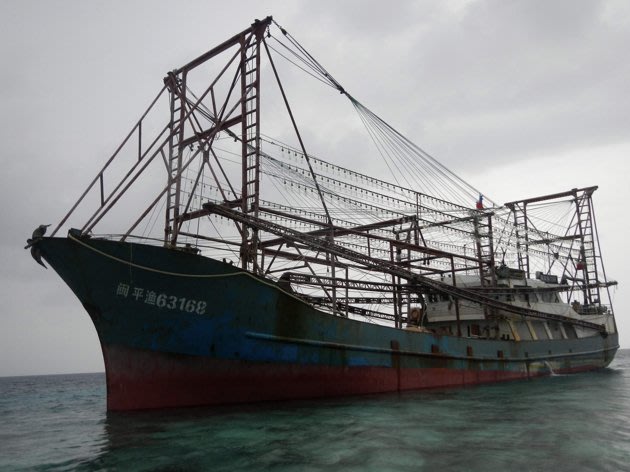
Chinese vessel that got stuck in Tubbataha April 8, 2013The recent case of the Chinese fishing Boat, which ran aground within sight of the Ranger Station in Tubbataha, is similarly instructive.

To begin with, it can be assumed that at least one of the crewmembers understands English (or even Tagalog!). They did not just wander deep into the Sulu Sea without such preparation. Jabbering in Chinese or playing their national anthem in response to official overtures just won’t wash. After all, they knew enough to communicate a desire to buy their way out of their predicament.

Our experience with Chinese “poachers” who intrude into our territorial waters is that they are invariably equipped with the requisite navigational and communications equipment. They can navigate well, even without the use of GPS, with their sextants complemented by tables of star elevations and coordinates (H.O. 214). They did not just make a mistake for which, therefore, they should be forgiven. They have no valid excuse for their illegal presence, and our laws should fully apply.

However, the argument put forward by a government spokesman that the difference in treatment with the Guardian case is an “apples and oranges” comparison does not hold water. The Guardian did not have the implied blanket permission to operate in Philippine waters. It had to have specific license to enter a highly restricted, “no take” area such as Tubbataha. In that sense, it is clearly in the same boat as the Chinese vessel.

The further claim that the Guardian incident was being investigated is likewise misleading since I don’t know of any Philippine effort to undertake such an inquiry. We appear to be satisfied with being merely invited to an investigation conducted by US authorities. And then, since we are dealing with the mighty United States of America, we quietly acquiesce to the findings.

Our tepid response to offenses committed by United States personnel, as in the Guardian incident, only serves to underline our inability to project a dignified image as a sovereign nation with respect to other countries. We were only too eager to placate Malaysia in the recent sad and ungraceful Sabah imbroglio. Finally, our attempts to apply the full force of the law in the case of the Chinese intrusion will challenge our ability to set the incident in the more significant context of our broader political and economic relations with China.

(The author is a retired Philippine Navy commodore. He is currently head of RCR Consultancy, a security risk management outfit. VERA Files is put out by veteran journalists taking a deeper look at current issues. Vera is Latin for “true.”)

Thursday, April 11, 2013

Tubbataha groundings and the folly of the Baselines Law

By Atty. Harry Roque Jr.
No lawyer can claim to have won all his cases. If any lawyer claims otherwise, he or she is obviously lying.
In public interest litigation, an actual victory need not be the ultimate goal. Sometimes, the fact that a petition against a tyrannical or a whimsical act of government is filed in court is victory by itself. This is because the filing of the petition is the message itself, forming part of an overall advocacy strategy intended to provoke public debates on issues involving the public interest.

Such was our concern when we challenged the constitutionality of the 2009 Archipelagic Baselines Law.
Our primary basis for challenge was because the law seeks, pursuant to the United Nations Convention on the Law of the Sea, to reclassify our internal waters into “archipelagic waters.”

Under this new regime, all vessels, including the USS Guardian or the Chinese fishing vessel that recently grounded in Tubbataha, are given the right to innocent passage in the waters within our straight baselines. This despite the fact that Article 1 of the 1987 Constitution refers to these waters as “internal waters.” Passage through internal waters always requires the consent of the coastal state, whereas the exercise of innocent passage does not.

Moreover, the UNCLOS provisions on archipelagic states allow aircrafts the right of overflight over these waters. Worse, it allows vessels transit passage, or non-suspendible innocent passage, in archipelagic straits. These are maritime superhighways governed by the same legal regime applicable in international straits. The legal regime in these waters is that vessels must always be allowed uninterrupted passage. If these transits are not designated, then the actual straight shall be determined through actual usage. This means that the West Philippines Sea, where 80 percent of all maritime traffic goes through, would be governed by the legal regime of international straights.

Obviously, our argument was that the constitutional “internal waters” could not be made into “archipelagic waters” either through law or through treaty. Only a constitutional amendment could achieve this.

But we lost our case. The Supreme Court said that despite the radically different legal regime of archipelagic waters, the scope and breadth of our territory had not been altered. It was not until the landing of the Royal Sulu Army in Sabah that I realized the import of the Court’s ruling in this regard—that even if the 2009 law did away with the provision in the 1950 baselines law that the use of basepoints and baselines was without prejudice to our claim to Sabah, the passage of the 2009 law did not abandon our claim to Sabah. This was a clear case of judicial legislation.

In any case, what the Convention approved as the regime for archipelagoes was not what our delegates to the UNCLOS wanted. They wanted, pursuant to our Constitution, the exercise of complete sovereignty and jurisdiction in our “internal waters” given that military vessels may otherwise be able to exercise the right of innocent passage through these waters. When they failed in this regard, the Senate, as a precondition to our ratification of the UNCLOS, required our delegation to deposit a “declaration” that our territory shall continue to be defined by our Constitution.

The grounding of the USS Guardian and the Chinese fishing vessel in Tubbataha are only the beginnings in the folly created by this archipelagic baselines law. In the past, neither vessel could have sailed through the Sulu seas without our consent. The law has done away with such consent. Worse, we have reduced by at least 229,000

square kilometers the scope of our territorial waters, which is subject to our sovereignty and jurisdiction. In this regard, the Supreme Court erroneously concluded that the loss had been compensated through our gain in terms of Exclusive Economic Zone.

This however, is non sequitur since a state can only exercise the right to explore and exploit the resources found in the EEZ. It cannot exercise powers of sovereignty in them.

Ultimately, the Court ruled that pacta sundt servanda—or treatyobligations must be compliedwith in good faith—should prevail even against an express provision of the Constitution. In so ruling, it forgot that the Constitution itself provides a policy crafted by the Filipino people. In the case of our territory, the sovereign people decreed that all the waters of our archipelago, because of national security considerations, precisely of the type that we now face with China, should be subject to our sovereignty and jurisdiction. But because Congress, when it legislated the 2009 law, and the Court, through its ruling in Magallona vs. Executive Secretary, defeated the will of the sovereign people in this regard,  expect the recent groundings in Tubbataha as a foreboding of worse things that are yet to come.

May the heavens help this land (and waters)!


For latest update on real estate development and its RA 9646, the Real Estate Service Act of 2009, visit www.ra9646.com.
 

Tuesday, June 21, 2011

Joint Marine Seismic Undertaking (2004)


An Agreement for Joint Marine Seismic Undertaking in Certain Areas in the South China Sea by and between China National Offshore Oil Corporation and Philippine National Oil Company (Copy furnished by Sen. Panfilo Lacson)

http://www.inquirer.net/specialfeatures/spratlys/documents/documents.php

PH ‘invaded’ Spratlys in 1970s, China tells UN

April 21, 2011 05:57:00
Philippine Daily Inquirer

MANILA, Philippines--China countered a Philippine diplomatic protest at the United Nations by saying it has indisputable sovereignty over the Spratly islands that the Southeast Asian country “started to invade” in the 1970s.

China’s diplomatic note to the UN, a copy of which was seen by The Associated Press on Tuesday, said the Philippine occupation of some islands and reefs in the Nansha islands infringes on China’s sovereignty. The Spratlys are known to the Chinese as Nansha islands.

A Philippine protest filed to the UN earlier this month said China’s claim to islands, adjacent waters, seabed and subsoil in the South China Sea had no basis in international law. The territorial claims were detailed in a map submitted to the UN in 2009.

The Philippines, China, Brunei, Malaysia, Taiwan and Vietnam claim in whole or in part the Spratlys—a group of islands, reefs and atolls in the South China Sea believed to be sitting atop vast oil and gas reserves.

Vietnam and Malaysia filed protests in 2009 against China’s map, and Indonesia, a nonclaimant to the disputed territory, also protested last year.

The protests are registered with the UN Commission on the Limits of the Continental Shelf, which will help mediate conflicting claims on territories.

‘Totally unacceptable’
China said the contents of the Philippine diplomatic note “are totally unacceptable to the Chinese government.”

The Philippines has said the Kalayaan Island Group in the Spratlys was an integral part of the country, which has sovereignty and jurisdiction over nearby waters and geological features under the international law principle that land dominates the sea.

China said the Kalayaan Island Group was part of its Nansha islands and its sovereign and related rights were supported by abundant historical and legal evidence.

It said before the 1970s, the Philippines never made any claims to the islands in a series of treaties defining its territory.

“Since the 1970s, the Republic of the Philippines started to invade and occupy some islands and reefs of China’s Nansha islands and made relevant territorial claims, to which China objects strongly,” said China’s April 14 note to UN Secretary General Ban Ki-moon.

China said the doctrine that a legal right cannot arise from an unlawful act applied, thus the Philippines could not rightfully claim the islands.

Asked for comment, the Department of Foreign Affairs (DFA) Wednesday said the note verbale sent by the Philippine Permanent Mission to the UN “speaks for itself.”

“We should leave it at that,” DFA spokesperson J. Eduardo Malaya told the Inquirer. Reports from Associated Press and Jerry Esplanada

http://http://www.inquirer.net/specialfeatures/spratlys/view.php?db=1&article=20110421-332362

China’s intrusions are connected to Gloria Arroyo’s deal


by Ellen Tordesillas

The current word war between the Philippines and China is another proof of the continuing   curse of Gloria Arroyo on the Filipino people.

The latest series of diplomatic protests lodged by the Philippines with China and submitted also to the United Nations have its roots to the controversial Joint Marine Seismic Undertaking entered into by the Arroyo government with China in 2004 which allowed China and later on Vietnam to explore not only the Philippine-occupied islands in the disputed mineral-rich Spratlys but areas that are clearly Philippine territory.

The JMSU was signed during Gloria Arroyo's 2004 visit to China which paved the way for the signing of at least two  graft-riddled deals : North Rail and national broadband network with ZTE agreements.

Last March, the Philippines filed a diplomatic protest when two Chinese patrol boats intruded into Reed Bank in Western Palawan where a seismic survey is being conducted by the Department of Energy with a private firm. The Philippine Navy in Western Command had to come in and drove away the Chinese ships in what Philippine officials assert as "Philippine territory."

It was followed by  a much-delayed protest last April  by the Philippines over China's nine-dash line map submitted to the United Nations Commission on the Limits of the Continental Shelf. China's map, submitted  to the U.N on May 7, 2009 supports their claim that the whole South China belongs to them including the Spratly islands which are being claimed in part by the Philippines, Vietnam, Malaysia, Brunei and Taiwan.

This month, the Philippines again protested the discovery on Amy Douglas that the Chinese have erected a number of steel posts and placed a buoy near the breaker of the bank also known as  Iroquois reef.  The Philippine Navy reported that Chinese ships were seen unloading building materials.
The Philippine Navy had removed the posts and the bouy.

After the Amy Douglas protest, the Philippines again filed another diplomatic protest over a February 2011 incident when two Philippine fishing vessels were fired upon by Chinese warships at Jackson Atoll. The fishermen sought the help of the Philippine Navy which accompanied them back to the area to retrieve their anchors.

The Navy reported seeing Chinese fishermen exploiting the marine resources in the area.
Philippine officials said all the areas that Chinese armed ships intruded lately were within the Philippines 200 nautical miles Exclusive Economic Zone. The Chinese, on the other hand, asserted its ownership over areas covered by the South China Sea.

This prompted the Philippines to adopt the term "West Philippine Sea" referring to the same areas in the same manner that Vietnam refers to the same area as East Asia Sea. (India, by the way, does not claim ownership of the Indian Ocean.)

Foreign Secretary Albert del Rosario and Defense Secretary Voltaire Gazmin are alarmed by the latest pattern of intrusions.

They don't want another Mischief Reef to  happen. In 1995, the Philippines discovered military-type structures on Mischief Reef, 150 nautical miles west of Palawan and 620 nautical miles southeast of China.
Despite Philippine protest, China never left Mischief Reef and has even expanded its fortifications in the island complete with h parabolic antennas and machine guns.

There's another thing that concerns the Aquino government.

When Del Rosario met with the Chinese Embassy charge d'affaires last May 31 over the Amy Douglas intrusion, he  conveyed the Philippine government's  concern over reports in Chinese state media about China's planned installation of its most advanced oil rig in the South China Sea next month.

Diplomatic sources said China's planned oil exploration is related to the JMSU which was not continued after the first phase because of questions of legality (the case is still pending with the Philippine Supreme Court) because the project included areas that were not disputed. Under the Constitution, "exploration. Development, and utilization of natural resources shall be under the full control and supervision of the State."

To go around the constitutional prohibition, the government changed the word "exploration" to "seismic survey."

The initial exploration/ seismic survey  to find out how much resources are there in the area. Based  on  the results, the Philippines, China, and Vietnam are supposed to jointly  develop the resources.  The Chinese provided the ships, Vietnam the scientists and the Philippines interpreted the data gathered.

With the information gathered from the survey, it was expected that development of the area would proceed. China's recent moves are seen as moving to the next phase of the project.The Philippines government, on the other hand, is stopped by questions on the legality of the  project.

Under the JMSU, Reed Bank, said to contain about 3.4 trillion cubic feet of natural gas and 440 million barrels of oil, is included. The Philippines now insists it is Philippine territory and not part of the disputed areas.

Oppositors to the JMSU had expressed concern that by entering into the project, the Philippines surrendered sovereignty over the resource-rich area and strengthened China's claim over it.

There were  allegations  that the Arroyo government's sell-out of  Philippine sovereignty  in  West Philippine Sea was connected to a number of  multi-million Chinese  loans for  projects  that became riddled with  graft and corruption.

That's  one of the crimes of Gloria Arroyo against the  Filipino people.

http://ph.news.yahoo.com/blogs/the-inbox/china-intrusions-connected-gloria-arroyo-deal-022615422.html