De La Salle University professor and security strategist Renato De Castro presented an important foreign policy challenge before the diplomatic and foreign policy community during the last July 29th Albert Del Rosario Institute roundtable discussions in Makati.
Focused on Philippines-Association of Southeast Asian Nations (ASEAN) relations with China, de Castro set the background for discussing the opportunities and issues that confront the post-Aquino III government.
The context: ASEAN prepares for the 2015 community-building project.
Current chair Malaysian Prime Minister Najib Razak’s statement of the 26th ASEAN Summit in Kuala Lumpur and Langkawi affirmed the progress made by member states in the various sectors of implementing the road map, the Initiative for ASEAN Integration (IAI) and the ASEAN connectivity master plan.
However, current ASEAN integration is taking place against Chinese expansionism in the South China Sea (SCS).
The Diplomat’s associate editor and Asian security expert, Prashanth Parameswaran, probes into the strategic unfolding of China’s “incremental assertiveness” or a “step-by step” process of operationalizing and enforcing its contentious nine dash line policy which began with creeping incursions in the Reed bank in 2009.
Its “reef expansion” activities proceeded with the de facto take over of the Scarborough shoal in 2012; placement of an oil rig in Vietnam’s exclusive economic zone in 2014 and massive land reclamations in 2015.
Centre for Strategic and International Studies senior associate, Bonnie Glaser was more categorical in describing China’s assertiveness in shifting from “rapid island building” in Fiery Cross, Johnson, Subi, Sand cay reefs, etc., to the militarization of reclaimed islands. According to Glaser, islands are now increasingly being equipped with military facilities such as airstrips and materiel for surveillance, monitoring and patrol.
The scale of China’s expansionism is so unprecedented that the transformation of the water features prior and after reclamation is now documented in a dedicated link in the Asia Maritime Transparency Initiative (http://amti.csis.org/island-tracker/).
ASEAN-China relations scholars are in agreement that China’s revisionism of the status quo in the SCS is fast overtaking the ability of ASEAN member states to conclude a Code of Conduct.
Scholars have argued that for the Philippines, the absence of a code may bear negatively on the outcomes of arbitration under the United Nations Convention on the Law of the Sea, especially when submerged islands are reclaimed and “generate” maritime entitlements for the littoral state.
Beyond rules formation, the Code of Conduct will be ASEAN’s “unified position” in dealing with China on the SCS matter. Twice did the ASEAN-Philippines attempt at an immediate passage of a Code of Conduct. First in 1999 as a reaction to Chinese military incursions in the Mischief Reef and second, in 2012, in response to the stand off between Philippines-China naval forces at Scarborough shoal.
History tells us that these failed attempts were reflective of the precarious nature of ASEAN centrality in the face of territorial conflicts with China. On the one hand, it also reveals much of the volatility of China’s commitment to proceed normatively on this issue.
Developments since 2012 have not only indicated the slow pace of ASEAN’s negotiations with China on the code of conduct but they have also ascertained China’s preference for “ambiguity” and dichotomy in approaching politico-security and economic issues and in engaging ASEAN in high and low politics.
Statements of the Chinese Foreign Ministry tell us that China does not see the need to expedite negotiations on the code.
It denies the existence of freedom of navigation issues in the SCS and insists that a regime on dispute settlement will evolve only after many maritime cooperative projects are cultivated between China and ASEAN, as a means of implementing the non binding Declaration on the Code of Conduct (2002). This includes projects on the low politics kind such as seminars/workshops on search and rescue, hotline communication, etc.
Yet, how does one build trust when mistrust has penetrated the high politics side of maritime affairs in the SCS?
A more perplexing question is found in China’s “dual track” approach to the SCS disputes.
China insists that ASEAN cannot assert a regional identity when bilateral conflicts are at stake.
Many ASEAN-China scholars have looked at this as a clearly Machiavellian strategy of divide and conquer. It mirrors a bigger actor’s condescending view of a smaller (regional) actor. In practice, the force behind any regional grouping is a united front. Not to recognize this for ASEAN undermines its role in the construction of a southeast Asian regional infrastructure.
Against what appears as tumultuous relations with China, are foreign policy opportunities in working with ASEAN’s non-claimant yet “interested” states of Singapore and Indonesia. Both have supported an expeditious and early conclusion of the code of conduct.
In addition, they have also argued that the SCS security extends beyond the realm of territorial and maritime disputes and towards non traditional piracy and terrorism that pose a real threat to regional stability.
Managing the outcomes of arbitration, possible joint development of SCS islands, coupled with Enhanced Defense Cooperation Agreement and the Armed Forces of the Philippines’ modernization as “inter-mestic” responses to an expansionist China will occupy the agenda of the next Philippine president. Indeed,the SCS issue shows that it is high time for the next administration to pay more attention to foreign policy.
Alma Maria O. Salvador, is Assistant Professor of political science at Ateneo de Manila University (ADMU).
Daisy See is assistant professor of Chinese Studies at ADMU.
source: Businessworld
Tuesday, August 11, 2015

Monday, August 3, 2015
Legislator to govt: Protect Recto Bank from China
OWING to the territorial dispute in the West Philippine Sea, a lawmaker on Sunday urged the government to protect the oil- and gas-rich Recto Bank, which holds the key to the country’s energy independence.
“We must secure and defend Recto Bank at all costs. We should assume jurisdiction over the conservation, exploration and exploitation of the seamount’s vast hydrocarbon deposits for the benefit of future Filipino generations,” House Deputy Minority Leader Arnel Ty said.
“We should not allow China’s protests and pestering to disrupt our efforts to harness Recto Bank’s oil and gas assets,” Ty, who speaks for the minority in the House energy committee, added.
Also called Reed Bank, Recto is a large underwater mount that rises just 9 to 45 meters short of the sea level. While the bank is well within the Philippines’s 200-mile Exclusive Economic Zone, it is the subject of a territorial row with China.
Ty, citing former National Security Adviser Roilo S. Golez, said China has been raring to seize and occupy Recto Bank.
Earlier, the US Energy Information Administration, citing geological surveys, estimated that the West Philippine Sea may contain up to 5.4 billion barrels of oil and 55.1 trillion cubic feet of natural gas, “with the bulk of the resources likely in the contested Reed Bank at the northeast end of the Spratlys.”
“Actually, studies of extensive seismic data indicate that Recto Bank’s Sampaguita gas field alone has up to 4.6 trillion cubic feet of natural gas and 115 million barrels of oil,” Ty said.
“To put this in perspective, the fully operational Malampaya gas field contains only up to 2.7 trillion cubic feet of natural gas and 85 million barrels of condensate,” he added.
The largest hydrocarbon deposit ever discovered in the Philippines, Malampaya now produces 146 billion cubic feet of gas every year, and the fuel drives three of Luzon’s largest power plants that are based in Batangas.
Meanwhile, the lawmaker also called on the government, particularly the Department of Energy (DOE), to lift the order that has shut down oil and gas drilling activities in Recto Bank, which lies just 80 nautical miles northwest off the Palawan coast.
In addition, Ty said that the consortium that runs the Recto Bank petroleum service contract (SC) should be permitted to resume its search for oil and gas supplies.
Forum Energy Plc., the private operator of SC 72, was originally set to drill two exploratory wells in Recto Bank this month.
However, in March, the DOE granted a force majeure order on SC 72, citing the territorial dispute with China and the ongoing United Nations arbitration proceedings.
Owing to the force majeure, Forum had to abandon all exploration work “until further notice from the DOE.”
Forum has a 70-percent interest in SC 72, with the remaining 30 percent held by Monte Oro Resources and Energy Inc.
Forum is majority owned by Philex Petroleum Corp., a Philippine Stock Exchange-listed entity run by businessman Manuel V. Pangilinan.
Tidemark Holdings Ltd., controlled by former Trade Minister Roberto V. Ongpin, also has a minority stake in Forum.
Meanwhile, an Australian-Filipino consortium over the weekend began drilling a deepwater exploratory well in the West Philippine Sea, hoping for an oil strike.
The group, led by Otto Energy Investments Ltd., intends to drill 1,000 meters below the sea bed and hopes to hit the top of a promising hydrocarbon reservoir in SC 55, a deepwater block in the southwest Palawan Basin that is not in disputed territory.
Using the 60,000-ton ultra-deepwater drillship Maersk Venturer, Otto expects to complete the spudding of the Hawkeye-1 well in 23 days at a cost of $24.5 million (P1.1 billion).
source: Business Mirror
Not only China, even allies are grabbing Philippine-claimed islands in Spratlys
THE Philippines lost four of the 11 islands it is claiming in the Spratlys to its allies Vietnam and Taiwan, in addition to the four reefs that China is now converting into military facilities.
During the forum on the West Philippine Sea held late last week, Defense Undersecretary for Strategic Assessment Raymund Quilop said that out of the 11 islands claimed or owned by the Philippines, three have been occupied and claimed by Vietnam, while the biggest island, Itu Aba or Taiping Island has been occupied by Taiwan.
Unlike China, Vietnam and Taiwan have not militarily fortified the islands that they have occupied during the past years, but instead developed them for commercial purposes or even resorts, escaping the attention of the Philippines and the international community.
One of the islands occupied by Vietnam, the Southwest Cay, is just more than a kilometer away from the Northeast Cay, which is occupied by Philippine troops. When Vice Adm. Alexander Pama was still the Navy flag officer in command, the Philippines and Vietnam agreed to jointly patrol the two islands and their surroundings against China.
Quilop said that the Philippine-claimed Kalayaan Islands Group (KIG) is composed of 11 islands and 86 features, that are also being claimed by China and Brunei Darussalam, in addition to Vietnam and Taiwan.
Of KIG’s reefs, two are occupied by the Philippines, 17 by Vietnam, three by Malaysia and seven by China.
China’s ongoing reclamation or development of the seven reefs that it occupies by turning them into military bases with ports that can accommodate its largest vessels and runways for its aircraft is making the international community and the country nervous because the activity was being undertaken to support its plan of dominating the South China Sea.
These reefs that are being made into artificial islands are Kagitingan Reef (Fiery Cross Reef), Calderon Reef (Cuarteron Reef), Burgos Reef (Gaven Reef), Mabini Reef (Johnson South Reef), McKeenan Reef (Hughes Reef), Panganiban Reef (Mischief Reef) and Zamora Reef (Subi Reef).
The Navy spokesman, Marine Col. Edgard Arevalo, said Subi Reef, where a runway is also being built by China, was the source of at least six challenges or harassments of Philippine patrols over the past weeks.
In those instances, China told the Filipino pilots to turn away because they are in Chinese territory. China also challenged on two occasions US patrols, but its warnings were laughed off by US pilots.
Supreme Court Associate Justice Antonio Carpio said the reclamation on Mischief Reef has reached about 500 hectares while that in Kagitingan Reef, already covers about 200 hectares.
Additional structures and fortifications are being built in the reclaimed areas.
Carpio said that at Burgos Reef, a four to five storey building has also been constructed.
source: Business Mirror
Tuesday, July 7, 2015
Hague arguments: Philippine case against China explained
The week covering July 7 to 13 will be pivotal to the Philippines’ legal battle to assert its claims over the portion of the South China Sea that it calls the West Philippine Sea.
A team of high-ranking government officials will present in The Hague, the Netherlands, arguments before the Arbitral Tribunal in the Permanent Court of Arbitration.
One of them is Supreme Court Senior Associate Justice Antonio Carpio, who has spoken extensively on the Philippines’ position in the maritime dispute with China.
Summing up the argument, he says the Philippines is asking the tribunal to declare China’s nine-dashed line void. The nine-dashed line is China’s purportedly historical boundary that takes up 85% of the South China Sea, including 80% of the Philippines’ exclusive economic zone (EEZ) in the West Philippine Sea.
Filipinos have been fishing in those waters for centuries.

While China stakes its claim based on its own version of history, the Philippine claim stands on international maritime law.
The United Nations Convention on the Law of the Sea (UNCLOS) entitles a coastal state to an EEZ of 200 nautical miles of sea from its coastline. In some cases, it includes rights to an extended continental shelf. That means the state has sovereign or exclusive rights to use and develop resources in and from the area.
China itself is a signatory to UNCLOS, although it says it does not subscribe to some of its tenets. For instance, its nine-dashed line contradicts the convention.
In its arbitration case, the Philippine government is asking the Arbitration Court to identify the maritime entitlements generated by islands and rocks in the West Philippine Sea in order to nullify China’s 9-dashed line.
Carpio says the UNCLOS supersedes historical claims so China cannot assert its nine-dashed line.
But here’s the clincher: this first round of talks is to determine whether the Arbitration Court has jurisdiction over the case in the first place.
In December 2014, China released a statement saying that the dispute is ultimately about sovereignty over islands, therefore the standoff is territorial, not maritime. If so, the tribunal would not have the authority to hear the case.
Assistant Secretary Charles Jose, spokesperson of the Department of Foreign Affairs (DFA), says, if the tribunal decides that it has jurisdiction over the case, it will ask the Philippine government to present its arguments on the maritime claim “at a future date.”
But if the tribunal decides otherwise, then that would be the end of the arbitration case.
In a briefing with reporters, Jose declined to say what the government would do next if the case were to be dismissed.
Carpio, however, is confident that the tribunal will affirm the Philippines’ position.

Even if China rejects the tribunal’s authority, a decision in favor of the Philippines will eventually result in international pressure on China to abide by the ruling.
He added that the case between Manila and Beijing will be a test for the international community: Will it uphold and defend the law or let Beijing get away with its sweeping claims?
Tuesday, June 9, 2015
300 -yr old map to boost Manila’s case
The Philippine government will be submitting to the United Nations Tribunal on the Law of the Sea in The Hague this week an almost 300-year-old map of the Philippines showing the disputed Scarborough Shoal being part of Philippine territory as far back as three centuries ago.
The map debunks the so-called nine-dash-line China has been using as proof of its claim over the South China Sea. It also locates Scarborough Shoal, then known as “Panacot,” also called “Panatag” by Filipinos, off the shores of Luzon, then known as Nueva Castilla. Scarborough Shoal has been a source of conflict between the Philippines and China.
The Jesuit priest Pedro Murillo Velarde had the map published in Manila in 1734. It surfaced in 2012 among the possessions of a British lord, who put it up for auction at Sotheby’s in London, where Filipino businessman Mel Velarde bid and got it for £170,500 ($266,869.46 or P12,014,463.09).
The first certified true copy of the map has been reserved for Malacañang. Velarde will personally present it to President Benigno Aquino 3rd on June 12, the anniversary of Philippine independence.
How Velarde, president and chief executive officer of Information Technology-based Now Corporation, acquired the map that had lain among the treasures of one of England’s most prominent families for more than 200 years is like something out of the movies. In fact, the wizard Harry Potter even makes a cameo appearance in the story.
Velarde is yet to find out if he is related to the Jesuit priest, although a possible connection was one of the motives for his pursuit of the artifact.
He said Supreme Court Justice Antonio Carpio, a long-time friend, suggested to him sometime in October last year to bid for the Murillo Velarde map. Velarde recalled that Carpio’s convincing line was: “You know, man, you’re a Velarde.”
Carpio, who has been conducting lectures debunking China’s claim to almost the entire South China Sea, calls the Murillo Velarde map the “Mother of all Philippine maps.”
Local public and private museums declined to take part in the Sotheby’s bid. The National Museum was interested but didn’t have the money, so the plan was for Velarde to buy the map and sell it later to the National Museum.
The Murillo Velarde map measures 1,120 mm by 1,200 mm. The Sotheby’s catalog carried a description of the map by Filipino historian and biographer Carlos Quirino: “Murillo Velarde’s map of the Philippines is a landmark in the depiction of the islands, and the first scientific map of the Philippines. It is flanked by two pasted-on side-panels with twelve engravings, eight depicting native costumed figures, a map of Guajam (Guam) and three city or harbor maps, notably Manila.”
The map was among 80 heirlooms that the current Duke of Northumberland, Ralph George Algernon Percy, decided to auction off after a devastating flood hit Northumberland County in April 2012.
Newspaper reports said heavy rains had “caused a culvert on the Duke of Northumberland’s land to collapse. Many residents were evacuated and some homes demolished after the foundations were damaged.”
Although the Duke’s estate did not own all the affected homes, he provided urgent help for his neighbors. The flood left him with a £12 million bill for repairs, hence the need to auction off his family’s collection.
As a bit of trivia, the Duke owns the vast Alnwick Castle, which has been featured as Hogwarts School of Witchcraft and Wizardry in the first two Harry Potter films.
Sotheby held the first auction on July 9, 2014 and the second on Novenber 4, 2014, both in London.
It was in the November auction that the Murillo Velarde map, called Carta Hydrographia y chorogphica de las Ylas Filipinas, Manila 1734, was included under Lot 183.
The Murillo Velarde map names two Filipinos as responsible for the map–Francisco Suarez who drew it and Nicolas de la Cruz Bagay who engraved it.
Historian Ambeth Ocampo wrote in his column in the Philippine Daily Inquirer, “The Murillo Velarde map of 1734 is quite rare, with [fewer] than 50 known copies to exist in the entire universe.”
Velarde registered to participate in the auction through an agent. He had participated in auctions in person before but his acquisition of the map last November was his first bid by phone.
The Sotheby’s auction took place at 9 p.m, Manila time while Velarde was in a Resorts World steakhouse for his mother’s 78th birthday dinner.
Velarde described the bidding, which lasted only for three to four minutes, as “furious.”
He was on the phone before Sotheby’s put Lot 183 on the auction block, and noted that in other lots, it was over after two to three bids.
Bidding for the map started at £30,000. He started to bid through his agent, thinking that he could go as high as £80,000.
Velarde said he could hear “30,000 pounds,… 40,000 pounds… 50,000 pounds. Fifty-five, sixty.” He said, “It seemed like so many were bidding.”
When the bidding reached £80,000, Velarde said he paused for a few seconds to decide whether to stop. The exchange rate was P68 to £1. He knew that the National Museum could allot only P5 million to buy rare items.
Then images of the Chinese occupying the contested islands in the Spratlys came to mind, according to him, and he decided to proceed.
“Pansariling away na, nagiging personal na sa akin [It became a personal crusade],” Velarde said. He eventually paid more than double the amount he thought he was willing to part with: £170,500.
When you buy a car, he said, you have something to compare it with. Not in the case of an old map. But Velarde also thought of the possible implications later, knowing that there is a pending case before the UN International Tribunal on the Law of the Sea against China. “You need some evidence.”
Velarde said he is thankful the auction was not held in Shanghai or Macau, where the map could have attracted Chinese bidders and the price would have been much higher.
Now that Velarde owns the map, the National Museum has informed him it has no funds to buy the map this year, and that there was some uncertainty about funds next year. Velarde decided to donate the map instead.
Why is he doing it?
“In a true-to-life movie, there’s a part for everybody. There’s a bully in the neighborhood. He already took over our land. We have soldiers in the Spratlys. Naka-standby lang sila [They’re just on standby there],” Velarde said.
“In a true-to-life movie, there’s a part for everybody. There’s a bully in the neighborhood. He already took over our land. We have soldiers in the Spratlys. Naka-standby lang sila [They’re just on standby there],” Velarde said.
“Then, this map is owned by a Duke in a Harry Potter castle. It’s like you wanting to play your part in the movie,” he added.
Velarde said he hopes to meet with the Duke of Northumberland someday. His children want to come along, not really for the Duke, who comes from a 700-year-old English aristocracy and is the fourth-largest landowner in the United Kingdom. They are excited to see the room where Harry Potter had his first flying lessons.
VERA Files is put out by veteran journalists taking a deeper look at current issues. Vera is Latin for “true.”
source: Manila Times
Thursday, June 4, 2015
PH, Japan agree to exchange defense materiel
TOKYO – Sharing the concern for threats to regional peace and stability, Philippine President Benigno Aquino III and Japanese Prime Minister Shinzo Abe signed on Thursday a joint declaration enhancing the two countries’ strategic partnership, agreeing to begin talks to exchange defense materiel, undertake more joint training exercises and ensure “maritime safety and security in the disputed South China Sea.
The two leaders signed the Tokyo declaration at the end of bilateral talks here early Thursday evening, following wide-ranging bilateral talks at the Akasaka Palace here.
The five-page declaration, which bolstered the strategic partnership the two nations first signed in 2011, also covered stronger “collaboration for economic growth” in the Asia-Pacific, and the pursuit of “enduring peace” in Mindanao.
A major part of the pact covers stronger defense ties between the two countries, including the “initiation of negotiations to conclude an agreement on the transfer of defense equipment and technology.”
Coming at a time when Japan has started rethinking its pacifist policy in the face of growing regional threats, the joint declaration also provided for the “expansion of bilateral and multilateral trainings and exercises for capacity building in areas including those covered by the memo on defense coopertion and exchange.”
In his remarks at a joint press conference, Abe issued an unequivocal condemnation of China’s reclamation activities in the South China Sea, part of which is being claimed by the Philippines.
“We once again confirm that we share serious concern about the large-scale land reclamation, and that we oppose attempts to unilaterally change the status quo,” said Abe.
He also again expressed support for the arbitration case the Philippines had initiated against China, to compel the military power to back off its exclusive economic zone in the South China Sea.
“We also agreed to thoroughly uphold the principle of the rule of law, and I once again conveyed our support for the utilization of the arbitration procedures by the Philippines,” he added.
Indirectly referring to China, meanwhile, President Aquino asserted the two nations’ commitment to urging other countries “to act responsibly” given “security challenges that confront both our nations.”
“We believe this can be done through finding just and peaceful solutions to our territorial disputes and maritime concerns by upholding the rule of law, towards creating a secure and stable environment that serves as the bedrock of our collective progress,” said Mr. Aquino.
In the Tokyo declaration, the Philippines and Japan reaffirmed “their strong commitment to ensuring maritime safety and security, including in the South China Sea, which is a vital element for peace and prosperity of the region including both countries.
It also reiterated the commitment of both sides to advocate freedom of navigation.
“Both countries reiterate their resolve to contribute to peace and stability in the international community…. Maintaining open and stable seas is essential in ensuring regional stability and is an imperative issue which both countries, as maritime nations,” the declaration read.
Amid continuing Chinese incursions in disputed waters, the declaration issued a common call for coastal states to “refrain from unilateral actions that would cause permanent physical change to the maritime environment in areas pending final delimitation.”
The two sides also underscored “the importance of [the] peaceful settlement of maritime disputes based on international law,” such as the United Nations Convention on the Law of the Sea.
The Philippines is invoking the same treaty in urging China to stop its incursions in the South China Sea, resting the thrust of its arbitration case on this international law.
source: PH Daily Inquirer
Tuesday, June 2, 2015
US Navy visits: Do we expect more of these?
I guess what US Defense Secretary Ashton Carter said during military ceremonies in Hawaii when he spoke with Secretary Voltaire Gazmin is no longer lip service as far as their commitment to the Philippines is concerned, with the US preparing to take on a more active role in ensuring freedom of navigation in the South China Sea. At the high-level international security meeting dubbed the “Shangri-La Dialogue” in Singapore, Carter called for “an immediate and lasting halt to land reclamation by all claimants” and that America will “oppose any further militarization of disputed features.”
According to Carter, the US is complementing India’s “Act East” policy and leveraging on America’s alliances and partnerships to seek new avenues of cooperation. The US Defense Secretary is visiting India to sign the 2015 US-India Defense Framework that covers everything from maritime security to aircraft carrier and jet engine technology cooperation, underscoring the seriousness of the United States in boosting alliances and strengthening its “trilateral network” in the Asia Pacific region.
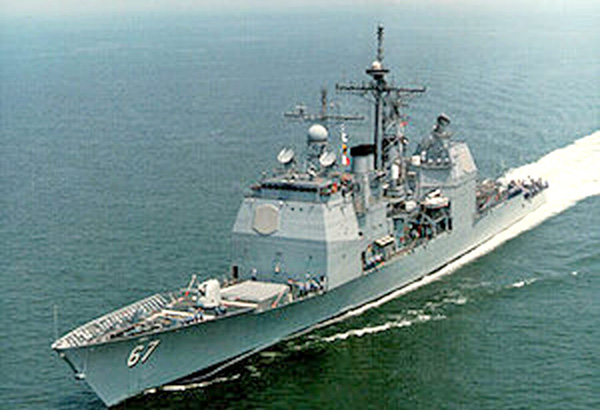
The presence in Subic of the US Navy missile cruiser USS Shiloh – forward deployed to Yokosuka in Japan and on patrol at the US 7th Fleet’s area of operations that include security support in the Indo-Asia Pacific region – is part of “routine port call,” according to Commanding Officer Capt. Kurush Morris, who said he is looking forward to getting back into their “routine of visits.” Which means we can expect more of these port calls from US Navy vessels on a rotational basis within the next year.
So far, the Philippines is still waiting for the Supreme Court to issue its ruling on the Enhanced Defense Cooperation Agreement (EDCA), but hopes are high that the decision will be favorable as it will enable the US to expand its presence in the country, not to mention allow the joint use of facilities and equipment between the US and Philippine armed forces – something that would probably irritate China no end.
The fact is, it’s not only the US and the Philippines that are telling China to stop all its reclamation activities in the disputed maritime territories. Australia has also issued a stern warning, following revelations by US defense officials that two big artillery vehicles were placed in one of the artificial islands it is creating. The discovery was made several weeks ago, but China however has since removed the weaponry according to sources.
P-Noy State Visit to Japan important

A large business delegation is joining President Aquino on his state visit to Japan with business matching sessions lined up to increase trade relations between the two countries. Preparations leading to the visit have been round-the-clock, and we must commend our Ambassador to Japan Manolo Lopez for tirelessly working to make sure that the visit is a great success. Over the years, our relations with the Japanese have been getting stronger, especially since Japan happens to be the biggest aid donor to the Philippines.
While trade and commerce will be a top priority during PNoy’s State Visit – with high hopes of increasing Japanese investments into the country – an underlying purpose would be defense and security issues in light of China’s escalating aggression and increasing reclamation activities in the disputed maritime territories in the South China Sea. In fact, a Chinese general attending the Shangri-La Dialogue in Singapore even floated the possibility of setting up an air defense identification zone above the disputed maritime territories – which could further inflame the situation.
Three weeks ago, Japan and the Philippines held the first joint naval exercises in the South China Sea west of Manila, with two Japanese Navy destroyers and 600 personnel taking part. The exercises of course are part of efforts to boost defense relations in light of China’s recent moves. Early this year, both countries signed a memorandum of understanding and just recently, Japan inked a deal to construct 10 multirole response vessels for the Philippine Coast Guard, and a major portion of the funds would come from the Japanese Official Development Assistance tied to the Japan International Cooperation Agency. The new vessels – expected to be delivered in 2016 until 2018 – is part of the government’s efforts to equip its forces with the necessary assets to “protect the national maritime interest.”
Shades of protection
Contrary to notion that sunglasses are more form than function, new evidence suggests that wearing shades can protect the eyes from various conditions including pinguecula – a condition where membranes on the white part of the eye near the cornea thicken, leading to a condition called pterygium which can permanently damage the eyes. This condition is more common among middle-aged and older people who spend more time in the sun.
Apparently, even just one day under the glaring heat of the sun without proper eye protection can result in short-term damage from ultraviolet rays, and this can get more serious with longer exposure. According to a survey conducted by The Vision Council, 26 percent of people never or rarely wear sunglasses. About 58 percent of Americans spend the most time outdoors during times when ultraviolet rays are strongest (8-10 am and 2-4pm) and therefore more risky for the eyes.
Interestingly, those with blue eyes are more susceptible because they have less of melanin. Aside from cataracts, macular degeneration, pinguecula and eye sunburn, temporary vision loss (which could lead to permanent blindness) are among the risks of too much sun exposure.
***
Email: spybits08@gmail.com
source: Philippine Star
Sunday, January 25, 2015
US-China rivalry
Last of three parts
THE South China Sea is now regarded by China as one of its “core national interest,” making it at par with Taiwan and Tibet. In view of this, China will never consent to a multilateral approach, especially one brokered by the US. Beijing is very sensitive about national sovereignty. It has been avoiding negotiations with Asean for the crafting of a legally-binding Code of Conduct in the South China Sea. The Asean Declaration on the South China Sea issued in 1992 and the Declaration on the Conduct of Pasties in the South China Sea of 2002 are both obsolescent. But in a body that makes decisions by consensus and where sovereign will adheres closely to national interest, a common stand by Asean or solidarity in forging a binding Code of Conduct with China is difficult to achieve. This matter has been pending for over a decade now.
The American “pivot” policy has caused deep concern in Beijing where it is viewed as a form of encirclement or a new containment scheme.
Thus, China is trying to create an exclusive Asian security cooperation framework, hoping to supplant the regional security order that has been dominated by the US. In May 2014, at a conference in Shanghai, Pres. Xi expressed the need to “let Asians deal with matters in Asia” and voiced a wish to form a new Asian order led by China. In the same month, China and Russia conducted joint military drills in the East China Sea with Pres. Xi and Pres. Vladimir Putin attending the opening ceremony. It appeared to be a move to convey a message against America’s joint exercises with Japan and South Korea.
In Brisbane, Australia, on November 15, 2014, Pres. Obama, on the margins of the G-20
Leaders Summit, insisted that the “pivot” policy was real and here to stay. He warned about the danger of conflict arising from China’s competing territorial claims against its rivals in Asia. The following day, Obama, Japanese Minister Shinzo Abe and Australian Prime Minister Tony Abbott issued a joint statement urging “freedom of navigation and overflight, and the peaceful resolution of maritime disputes in accordance with international law.”
Leaders Summit, insisted that the “pivot” policy was real and here to stay. He warned about the danger of conflict arising from China’s competing territorial claims against its rivals in Asia. The following day, Obama, Japanese Minister Shinzo Abe and Australian Prime Minister Tony Abbott issued a joint statement urging “freedom of navigation and overflight, and the peaceful resolution of maritime disputes in accordance with international law.”
They also said that they were committed to deepening their already strong security cooperation in the Asia-Pacific, in obvious reference to China’s increasingly assertive expansion in the region.
Not to be outdone, Pres. Xi, in addressing the Australian parliament the day after, expressed China’s “unshakeable resolve to pursue peaceful development. Neither turbulence nor war serves the fundamental interests of the Chinese people.” This was a rehash of what Xi said on 12 July 2014 at a conference in Beijing marking the 60th anniversary of the Five Principles of Peaceful Coexistence. He stated: “Hegemony or militarism is not in the genes of the Chinese.” Xi’s statement in Sydney was also in reaction to Obama’s call in Brisbane for China to act as a responsible actor on the world stage.
It will be noted from this article that both the US and China had used grandiose terms, semantics and jargon to project their aims and objectives.
They know only too well that international politics thrives in the use of “word politics”. It’s either you take them at face value or dismiss them as plain gobbledygook. What matters is the resolve of the parties involved.
Now, who is winning the battle for the heart and mind of the people in Asia? An 11-nation survey of influential but non-governmental experts conducted by the Washington – based Center for Strategic and International Studies found that elites largely expected China’s clout to keep growing but are more receptive to US leadership and robust role in the region.
A China expert at the Center said Southeast Asian nations preferred a “quiet, persistent presence by the United States.” The survey was released in June 2014.
TIME magazine said only North Korea, Russia and Pakistan are widely acknowledged as close allies of China.
source: Manila Times' Column of JUANITO P. JARASA
Thursday, January 22, 2015
China island building ‘threat to all Asean': Philippines
China’s reclamation of land in disputed South China Sea waters is a “threat” to all nations in Southeast Asia, the Philippines’ foreign minister said Thursday.
Albert del Rosario repeated a warning last year that Beijing was reclaiming land around isolated reefs in the South China Sea to turn them into islands which could hold fortified positions or even airstrips.
The Philippine foreign secretary said the Chinese actions in the Spratly islands would impact freedom to navigate the strategic mineral-rich waters, through which large volumes of the world’s trade pass.
“I will re-emphasise this and invite the concern of the Association of South East Asian Nations (Asean) states because it is a threat to all of us,” del Rosario told reporters.
Manila accused Beijing last year of reclamation work in the Cuarteron, Johnson, Johnson South and Gaven reefs in the Spratly group, which the Chinese call Nansha.
China claims almost all of the South China Sea, a claim which conflicts with those of Asean members Brunei, Malaysia, the Philippines and Vietnam as well as non-member Taiwan.
Beijing has previously rejected Philippine protests that the land reclamation was being conducted in its territory, with a People’s Liberation Army Major General Luo Yuan defending it as “justifiable” in state media.
While the Philippines and Vietnam have been vocal in accusing China of aggressive actions, other Asean members have been reluctant to criticize the regional giant.
Del Rosario said he would raise the issue at an upcoming meeting of Asean foreign ministers, pushing for countries involved in the dispute to adhere to a code of conduct to not increase tensions in the maritime region.
He said the Philippines hoped to receive a positive decision by early next year to the formal plea it filed to the United Nations last March challenging China’s claims.
A US official attending a strategic dialogue with the Philippines on Wednesday also expressed concern over China’s behavior in the South China Sea.
“We believe bigger nations can’t bully the small,” assistant secretary of state Daniel Russel told reporters after the two-day dialogue.
source: Manila Times
Monday, December 29, 2014
Ruling on Phl maritime case vs China seen next year
MANILA, Philippines - A ruling on the Philippines’ case against Chinese claims in the South China Sea could be the most significant move by any tribunal established under the United Nations Convention on the Law of the Sea (UNCLOS).
However, a finding of no jurisdiction by the judges over the case will dim hopes of using arbitration as a peaceful means of resolution in the future.
Officials at the US think tank Center for Strategic and International Studies (CSIS) said a tribunal at the Permanent Court of Arbitration in The Hague would likely rule on the Philippine case against Chinese claims by the end of 2015 or 2016.
This is expected to shape Southeast Asia as other countries which have claims in waters in the South China Sea are watching the case, Murray Hiebert, a senior fellow and deputy director of the Sumitro Chair for Southeast Asia Studies at the CSIS in Washington, and Gregory Poling, a fellow with the Sumitro Chair, said.
“Decision could be the most significant by any tribunal established under the UNCLOS,” Hiebert and Poling pointed out.
CSIS Sumitro Chair for Southeast Asia Studies is a forum for high-level policy dialogue focusing on the region and US interests.
The Philippines initiated an arbitration case against China to challenge its so-called “nine-dash line” position, an expansive claim of “indisputable sovereignty” over almost the entire South China Sea.
“If the judges find that they do not have jurisdiction, it will dim hopes of using arbitration as a peaceful means of resolution in the future,” Hiebert and Poling said in their commentary.
“But if the judges do find jurisdiction, they will almost certainly rule China’s nine-dash line an invalid claim to maritime space.”
China has rejected arbitration and indicated that Beijing is not participating in the arbitration process.
The Permanent Court of Arbitration set Dec. 15 for Beijing to submit its counter-memorial response to Manila’s written arguments.
But China ignored the deadline and argued the arbitral tribunal does not have jurisdiction over the case.
In that case, Beijing, which maintains that it will not take part in the proceedings and will not submit its arguments, “will face some difficult choices,” Hiebert and Poling said.
source: Philippine Star
Tuesday, December 23, 2014
‘Lawyers united vs China’s sea claims’
Lawyers do not see eye-to-eye on anything because they actually make a living out of disagreements. But according to one of the country’s foremost foreign affairs and economic analyst, with regards to the question of territorial sovereignty in the South China Sea, there is practically a general agreement among legal eagles, both here and abroad, that China’s “nine dash line” claim is in conflict with international law.
“I talked to top international lawyers and experts from New York, (Washington) DC to Hawaii,” said Prof. Richard Heydarian in a television interview Monday.
“It’s rarely that lawyers agree on anything, they make money out of disagreements. But on this issue practically there’s a consensus that the nine dash line is inconsistent.”
He pointed out that many lawyers argue that one can only claim historical rights over waters such as bays or coastal waters but not all the way into the high seas.
“In fact around 50 years ago, China itself in one of its documents conceded that South China Sea constitutes high seas,” said Heydarian who recently visited the US to discuss with government and university experts issues related to the United Nations Convention on the Law of the Seas (UNCLOS) and the South China Sea territorial dispute.
On the other hand, Heydarian described the Philippine strategy as “smart” considering that “UNCLOS is not just about certain sovereignty, it’s all about territorial delimitation.”
source: Manila Bulletin
Monday, December 15, 2014
DFA lauds Vietnam’s role in UN arbitration
VIETNAM has helped ensure peace in the South China Sea dispute with Beijing by following the Philippines in seeking UN arbitration, the Philippines’ Department of Foreign Affairs (DFA) said.
Beijing claims almost the entire energy-rich South China Sea, but Brunei, Malaysia, the Philippines, Vietnam and Taiwan also have claims. Only Brunei has not occupied and garrisoned territory in the potential flash point in the region.
Vietnam on Thursday submitted its position to a UN arbitration tribunal initiated by the Philippines over the festering dispute. China called on Vietnam to respect its sovereignty and has refused UN arbitration.
“The Vietnamese position is helpful in terms of promoting the rule of law and in finding peaceful and nonviolent solutions to the South China Sea claims based on international law,” the DFA said. “This promotes peace and stability in our region.”
China, Vietnam, and the Philippines are signatories to the UN Convention on the Law of the Sea, an international agreement that grants the right to explore and exploit resources within 200 nautical miles of a state’s shore. Both Hanoi and Manila say Beijing is extending beyond the limit.
In May, China placed its largest mobile oil rig close to Vietnam’s coast in the Paracel islands that prompted angry protests in Hanoi against Chinese business interests. At the same time, Beijing began reclamation in the Spratly islands and appeared to be building airstrips in the area.
Beijing has also seized control of Scarborough Shoal near the Philippines’ main island of Luzon and chased civilian ships delivering supplies to Philippine-held Second Thomas Shoal in the Spratlys.
The Philippines and Vietnam appear to be ending decades of distrust. Last year, the two sides held a first-ever navy-to-navy talks and last month, Hanoi displayed its two most powerful missile-guided stealth frigates in Manila during a port call. The two states will hold the first strategic defense dialogue early next year.
“Vietnam’s legal opinion puts political weight on the Philippine legal case,” Professor Rommel Banlaoi, a security analyst, said on television.
“What Vietnam did was in fact supporting, reaffirming, and even rallying behind the Philippine legal action and that’s good for our national interest.” -- Reuters
source: Businessworld
Wednesday, November 26, 2014
Manila files protest vs Beijing for building structures on Spratly Islands
DEPARTMENT of Foreign Affairs (DFA) Secretary Albert F. del Rosario confirmed on Tuesday that the agency had filed a diplomatic note to China on Oct. 10, protesting the construction of structures in the Kagitingan Reef, which is included in the Philippines’ claim on the contested Spratly Islands.
Speaking to reporters on the sidelines of Senate budget deliberations, Mr. del Rosario said in sending a “note verbale” to China dated Oct. 10, the agency was “protesting the activity” in the disputed features in the South China Sea.
Mr. del Rosario told reporters the previous day that the agency was still “validating” the reports claiming that China’s reclamation activities was in the advanced stage and that an airstrip is being built on the reef.
“We just checked,” he told reporters on Tuesday. “We looked at our records and discovered that a note verbale has already been sent.”
The Chinese-occupied reef -- called Fiery Cross Reef in English, Yongshu Jiao in Chinese -- is also claimed by the Philippines and Vietnam.
Armed Forces of the Philippines (AFP) Chief-of-Staff Lt. Gen. Gregorio Pio P. Catapang, Jr. told reporters that the military was still “checking out” the facilities that have been erected in the reef and is currently confirming if an airstrip existed.
“As of now, the DFA has the lead role, so whatever the findings of the DFA [are], we [will] just await their instructions on what the AFP has to do,” Mr. Catapang said.
He added that Filipino troops were still able to maintain presence on the islands the country currently occupies “because nobody bothers them.” -- Vince Alvic Alexis F. Nonato
source: Businessworld
Tuesday, November 11, 2014
Noy raises sea row at APEC
BEIJING – In a gathering of Asia-Pacific leaders where the economy is the main agenda, President Aquino raised the West Philippine Sea issue, particularly efforts by his administration to resolve territorial disputes through international arbitration.
In a press briefing at the Philippine embassy here yesterday, Foreign Affairs Secretary Albert del Rosario said the maritime row was “touched broadly” in all of the five bilateral meetings.
The President is in the Chinese capital for the Asia-Pacific Economic Cooperation (APEC) summit.
“For example, in the case of Vietnam, there was common agreement that we would continue to pursue dispute settlement on the basis of peaceful means in accordance with the rule of law using UNCLOS (United Nations Convention on the Law of the Sea),” Del Rosario told members of the Philippine media.
Aquino also discussed the issue with leaders of Canada, Papua New Guinea, New Zealand and Thailand.
China, the Philippines, Vietnam, Malaysia, Brunei and Taiwan have overlapping claims over the West Philippine Sea and South China. But host country China has been flexing its military muscle to assert its claim over almost the entire South China Sea and West Philippine Sea.
With Canada, Del Rosario said there were also “broad discussions on the application of international law in resolving regional disputes.”
Aquino met with Vietnamese President Truong Tan Sang Sunday night and with Canadian Prime Minister Stephen Harper, Papua New Guinea Prime Minister Peter O’Neill, New Zealand Prime Minister John Key and Thai Prime Minister General Prayuth Chan-ocha yesterday.
Del Rosario said the Philippines and Vietnam reaffirmed their friendship and agreed to convene a joint committee in December to start discussions on a roadmap towards a strategic partnership on improving trade, investment and people-to-people exchanges.
“I think that it (strategic partnership) is mostly driven by our close ties with them, and we actually have entered into a strong commitment to be able to bring our relations closer, and the way to do this is through some form of a comprehensive strategic partnership,” Del Rosario said. “We still have to craft exactly what we mean by that. It’s possible that we need to integrate our thoughts in terms of what do we mean by ‘comprehensive strategic partnership.’ But I think there’s enough of a history in terms of our relations and the fact that we have very close ties to get us to where we want to go,” he said.
Japan, China deal OK
Del Rosario welcomed the agreement between China and Japan to develop mechanisms to gradually resume talks, which had been stalled for at least two and a half years, due to their maritime spat over the Senkaku Islands.
“We viewed that as a positive development if... it contributes to peace, security and stability in the region,” Del Rosario said.
The foreign affairs chief said the Philippines had always taken the position that the West Philippine Sea dispute should not be the sum total of relations between Manila and Beijing.
“As you know, our position has always been that China is a friend and a neighbor, and we are at all times working for a constructive relationship with them – one that is mutually beneficial,” he said.
He said Aquino and then Chinese President Hu Jintao agreed in 2011 that bilateral relations involved many facets and that “contentious issues” could be treated “separately.”
Aquino went on a state visit to China in 2011 upon the invitation of Hu but had to cancel a visit to a trade expo in Nanning last year after reportedly being “disinvited.”
“And so, we have been working to have this agreement honored because we are, of course, very interested in being able to again have a close relationship with China, whom we consider as a valuable friend,” Del Rosario said.
No hostile move
He also reiterated that arbitration was not a hostile move and was intended precisely to maintain peace.
“We have had questions about our motives for arbitration. We went into arbitration after we had exerted every possible reasonable means to arrive at a peaceful settlement of the dispute,” Del Rosario said.
“But this was our last resort and arbitration is, for us, a means for clarifying entitlements for all nations involved in this dispute so that this can be used as a way to move forward in terms of settlement of these disputes that we speak of,” he pointed out.
“We precisely selected arbitration because, as was defined by the United Nations, it is not an unfriendly act. It is, as a matter of fact, one that we are utilizing to be able to preserve a valuable friendship,” he added.
Asked if Aquino and Chinese President Xi Jinping would have a chance to meet, Del Rosario could only say “there’s a possibility.”
He said he had congratulated China for the hosting of the APEC, which had been successful so far.
Canada visit
Del Rosario also said President Aquino received an invitation from Canada’s Harper to visit the North American nation next year.
Del Rosario said Harper had also inquired about the progress of rehabilitation in areas devastated by Super Typhoon Yolanda last year.
He said Aquino and Harper talked about the inclusion of the Philippines among Canada’s priority development partners. “They have this development program and the Philippines was selected to be one of those countries that would enjoy this thrust,” Del Rosario said.
The foreign affairs chief said the President thanked Canada for its “overwhelming support” for Yolanda victims.
Del Rosario said Harper was quite pleased with the developments reported to him.
“There was also a benefit given to the Philippines in terms of a trade priority... which focuses on providing a two-way trade and market access to the Philippines,” Del Rosario said.
He also revealed discussions on the Islamic State but did not give details.
Del Rosario said Aquino and Harper both acknowledged the global threat posed by IS.
“And this is already myself speaking – that we cannot ignore the crimes and atrocities and the fact that... we must take a position against those who perpetrate crimes against humanity,” Del Rosario said.
Del Rosario said they thanked Canada for its steady assistance to the Philippines’ chairmanship in 2015.
Del Rosario also said the Philippines and Papua New Guinea were moving for improved trade and investment cooperation.
“We want to advance cooperation in health services. It appears that the Philippines is emerging as a favored destination for medical tourism. We are being asked to advance our cooperation in education, specifically technical and vocational programs,” Del Rosario said.
“It seems that many Papua New Guinea nationals are now studying in the Philippines. And, of course, there was a discussion on the deepening of our cooperation in agriculture,” he added.
“For example, IRRI (International Rice Research Institute) explores finding suitable rice species for Papua New Guinea,” he added.
Papua New Guinea will chair APEC in 2018 and its leader sought the Philippines’ support for the tiny nation’s hosting as “we seek their cooperation for our chairmanship in 2015.”
Thankful to Thais, NZ
The Philippines, Del Rosario said, also expressed gratitude to Thailand for the latter’s assistance to Yolanda victims.
He said Manila eagerly awaits the forthcoming visit of the prime minister and the foreign minister, separately.
“We are desirous of promoting greater cooperation in trade and investment with greater focus on the support for our SMEs (small and medium enterprises) and our farmers,” he said.
“We exchanged views on best practices on instituting government reforms. And the President was briefed on the plans of the new Thai government in terms of their effort to return to democracy,” he added.
Del Rosario also said Aquino and New Zealand’s Key discussed improved air links between the two countries.
“We commended the pace of relations with New Zealand, particularly the expansion of air links between the Philippines and that country,” Del Rosario said.
source: Yahoo!
Tuesday, November 4, 2014
United stance by ASEAN on territorial disputes in leaked draft statement
The leaked contents of a draft statement supposed to be delivered by the chair at the 25th Association of Southeast Asian Nations (ASEAN) Summit to be held in Myanmar’s administrative capital Naypyidaw on November 12, presents a more united ASEAN determined to push for the early conclusion of a Code of Conduct (COC) in the South China Sea.
Four ASEAN member states — the Philippines, Vietnam, Malaysia and Brunei — are involved in separate maritime disputes with an increasingly assertive China.
Based on the alleged draft statement, the ASEAN leaders are to express concern over recent developments in the South China Sea and reaffirm the importance of regional cooperation in maintaining peace and stability.
“We expressed our concerns over recent developments in the South China Sea, which have increased tensions in the area,” the statement reads. “We reaffirmed the importance of regional cooperation in maintaining peace and stability, promoting maritime security and safety, and the freedom of navigation, including in and over-flight above the South China Sea.”
Further, the draft says the ASEAN leaders urge all parties involved in the disputes to exercise self-restraint, settle the issue through peaceful means and in accordance with international law, including the 1982 United Nations Conventions on the Law of the Sea (UNCLOS).
The leaders also highlight the importance of maintaining the momentum of negotiations and in achieving early a COC.
source: Manila Bulletin
Subscribe to:
Posts (Atom)